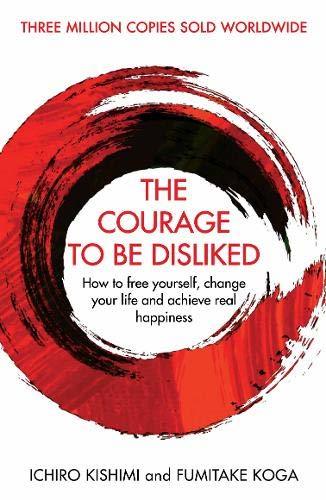
The Courage To Be Disliked
Ichiro Kishimi and Fumitake Koga
My take
This book arrived at the right moment. I was somewhere in the middle of trying to figure out what I actually wanted versus what I’d convinced myself I wanted because it made sense to others. Kishimi and Koga present Adlerian psychology as a dialogue between a philosopher and a skeptical young man, and the format works because the skeptic asks every objection you’d raise yourself. The central provocation is this: your past does not determine your present. Not because trauma isn’t real, but because we use the past as an excuse to avoid making choices in the present. That’s a hard thing to sit with. The book’s bigger argument is that almost all suffering comes from our relationships with other people, specifically from trying to manage what others think of us. The antidote isn’t indifference. It’s something more demanding: accepting that freedom and approval cannot both be maximized, and choosing freedom anyway.
Core insight 1: The past doesn’t determine you, your choices do
Adler breaks from Freud entirely here. Freudianism asks why we are the way we are, tracing behavior back to cause. Adler asks: what are you trying to achieve by being this way? The difference sounds subtle but it lands differently. It means the stories we tell about our past are not explanations, they are strategies. We reach into memory and pull out reasons to stay put.
People are not driven by past causes but are moving toward goals that they themselves set.
How to practice: When you catch yourself explaining a limitation through past experience, ask what staying stuck is protecting you from. The answer is usually more revealing than the story.
Core insight 2: All problems are interpersonal relationship problems
This sounds like an overstatement until you actually sit with it. Every anxiety, every self-doubt, every feeling of inadequacy is relational at its root. We’re not afraid of public speaking because we dislike speaking. We’re afraid because we care what the audience thinks. We’re not stuck in work we hate because we lack options. We’re stuck because changing would disappoint someone whose approval we’ve been quietly managing.
It is always within the context of your relationship with someone that you judge yourself as inferior.
How to practice: When you feel stuck or distressed, trace it to its relational root. Who specifically are you worried about? What specifically do you fear they’ll think? That’s the real problem to address.
Core insight 3: Separate your tasks from others’
This is the most immediately useful tool in the book. Kishimi introduces the concept of “the separation of tasks”: before reacting to any situation, ask whose task it actually is. Your task is what falls within your choices and actions. Everything else belongs to someone else. Whether someone likes you is their task. Whether your work is appreciated is their task. You’re responsible only for doing it well.
You are not living in order to satisfy other people’s expectations, and neither am I living in order to satisfy your expectations.
How to practice: In any moment of anxiety or conflict, ask: is this my task or theirs? If it’s theirs, your only job is to stop interfering with it.
Core insight 4: Life lies are the stories we use to stay safe
The book introduces a concept that stings a little: “life lies.” These are the narratives we construct to justify not changing. I can’t because I’m too sensitive. I can’t because of what happened to me. I can’t because the timing isn’t right. Adler’s position is that we write these stories with intention, not passively. We need the excuse more than we need the change.
The real issue is that it’s frightening to take a step forward. It’s scary to change. So you end up not changing.
How to practice: When you notice a “because” in your thinking about why you can’t do something, treat it as a hypothesis rather than a fact. Is this a real constraint or a constructed one?
Core insight 5: Freedom is being disliked by some people
This is the reframe the whole book builds toward. Most people treat approval as a prerequisite for action. If I make this choice, will they think badly of me? That calculus quietly governs enormous parts of how we live. Adler’s argument: the desire to be liked by everyone is a choice to live someone else’s life. Freedom costs something specific. It costs the universal approval you were never going to have anyway.
If you are not living your life for yourself, then who is going to live it for you?
The courage to be happy also includes the courage to be disliked. When you have gained that courage, your interpersonal relationships will all at once change into things of lightness.
How to practice: Identify one choice you’ve been avoiding because of how it might land with a specific person. Ask what you’d do if their opinion were irrelevant. That’s usually the right move.
Core insight 6: Horizontal relationships over vertical ones
We habitually relate to people through vertical structures: better or worse than, above or below, praising or being praised. Adler calls for horizontal relationships instead, where you relate to others as equals regardless of role or status. This isn’t just idealism. Vertical relating breeds either arrogance or inferiority, and neither is useful. Horizontal relating requires seeing other people as they are rather than as positions in a hierarchy.
No matter how much you praise or give encouragement, if it is done in a vertical relationship, it turns into manipulation.
How to practice: Notice when you use praise as a form of judgment (“you did well”), which still positions you as the evaluator. Try acknowledgment instead (“I notice you worked hard on this”).
Core insight 7: Self-acceptance is not self-affirmation
There’s a meaningful distinction here. Self-affirmation says: I believe I can do it even if I can’t. Self-acceptance says: I am the person I am right now, and I act from that reality. The first is a form of magical thinking. The second is honest engagement with where you actually are. Acceptance is not resignation. It’s the only accurate starting point.
The important thing is not what one is born with, but what use one makes of that equipment.
How to practice: When you catch yourself in a loop of self-criticism, shift from “I shouldn’t be this way” to “I am this way, what do I do from here?” The latter is more actionable and more honest.
Core insight 8: Happiness is contribution
The book ends here, and it’s a surprise coming from a philosophy that leans so hard on individual freedom. Adler argues that genuine happiness is found in community feeling, in the sense that you are contributing to something beyond yourself. This doesn’t mean self-sacrifice. It means that the deepest sense of worth comes not from achievement or approval but from the feeling that you matter to others in a real and specific way.
It is at that point that the individual can finally accept themselves, can feel that it is okay to be here, and can even feel genuine happiness.
How to practice: Ask yourself at the end of each day not what you accomplished, but who you contributed to. That metric tells a different story about what mattered.
Every few years a book comes along that feels less like new information and more like a permission slip. This one gave me permission to stop optimizing for approval. Not to become indifferent to others, but to stop treating their opinions as the raw material of my identity. The philosophy is old. The application is immediate.
Other reminders
No matter how much you think you are right, that does not mean other people are wrong.
The world is simple, and life is too. It is only the individual who complicates it.
If you are not living your life for yourself, then who is going to live it for you?
It is not that you lack competence. You lack courage.
People can change. And not only that, people can find happiness.
The world is not complicated. It is just that you are always looking for excuses.
We can determine our own lives according to the meaning we give to those past experiences.
Happiness is the feeling of contribution.
We are not determined by our experiences, but by the meaning we give them.
A healthy feeling of inferiority is not something that comes from comparing oneself to others, but from one’s comparison with one’s ideal self.
Enjoyed this? You'll like Open Loops.
Every Thursday, I share what I’m learning about growth, work, and the long game. Join 3K+ readers.
You might also like