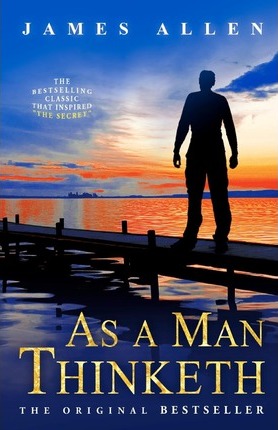
As A Man Thinketh
James Allen
My take
This is one of those books that says in 30 pages what most self-help books take 300 to circle around. James Allen wrote it in 1903, and somehow it still cuts deeper than anything published this century on the same subject. The premise is almost uncomfortably simple: you are what you think. Not what you wish. Not what you say. What you actually think. Your character, your circumstances, your health, your relationships, all of it is downstream of the thoughts you cultivate. When I first read it, I resisted the idea that circumstance doesn’t shape us. But Allen isn’t saying bad things don’t happen. He’s saying your inner world is always the author of how you experience the outer one. That reframe changed how I look at everything, from setbacks to success. The book doesn’t let you off the hook. It hands you full responsibility, and that turns out to be the most liberating thing it could offer.
Core insight 1: You are literally what you think
This is the foundation of the entire book. Not metaphorically, not eventually. Right now, your character is the complete sum of your thoughts. Allen doesn’t leave room for negotiation on this.
A man is literally what he thinks, his character being the complete sum of all his thoughts.
Man is made or unmade by himself; in the armoury of thought he forges the weapons by which he destroys himself; he also fashions the tools with which he builds for himself heavenly mansions of joy and strength and peace.
This isn’t about positive thinking or affirmations. It’s about recognizing that every thought you entertain is actively building or eroding who you are. There’s no neutral ground. You’re always becoming something.
How to practice: Pay attention to the thoughts you return to when no one is watching. Those recurring patterns are the blueprint of your character. If you don’t like what you see, the work starts there.
Core insight 2: Circumstance reveals, it doesn’t create
One of the sharpest ideas in the book. We love to blame our conditions for our problems. Allen says conditions are just mirrors.
Circumstance does not make the man; it reveals him to himself.
Man is buffeted by circumstances so long as he believes himself to be the creature of outside conditions, but when he realizes that he is a creative power, and that he may command the hidden soil and seeds of his being out of which circumstances grow, he then becomes the rightful master of himself.
The moment you stop seeing yourself as a victim of what’s happening around you, everything shifts. Not because the world changes, but because you stop giving it permission to define you. Circumstance is feedback, not fate.
How to practice: Next time something goes wrong, resist the reflex to blame the situation. Ask instead: what does this reveal about the thoughts and patterns I’ve been cultivating? The circumstance is the symptom. The thought is the cause.
Core insight 3: Wishes and prayers mean nothing without aligned thought
Allen draws a hard line between wanting something and actually earning it through the quality of your thinking. Desire alone is empty.
Not what he wishes and prays for does a man get, but what he justly earns. His wishes and prayers are only gratified and answered when they harmonize with his thoughts and actions.
Men are anxious to improve their circumstances, but are unwilling to improve themselves; they therefore remain bound.
This is the part most people skip. They set goals, visualize outcomes, repeat affirmations, then wonder why nothing changes. Allen’s answer: because your thoughts and actions haven’t changed. The universe doesn’t respond to what you want. It responds to what you are.
How to practice: Look at the gap between what you say you want and how you actually spend your mental energy. If there’s a mismatch, that’s the answer. Align your daily thinking with your deepest intentions, or accept that the wish will stay a wish.
Core insight 4: Thought must be linked with purpose
Without purpose, thought drifts. And drifting, Allen argues, is a form of self-destruction. Not dramatic, but slow and steady.
Until thought is linked with purpose there is no intelligent accomplishment.
Thoughts of doubt and fear never accomplished anything, and never can. They always lead to failure. Purpose, energy, power to do, and all strong thoughts cease when doubt and fear creep in.
Purpose gives thought direction. Without it, even brilliant minds scatter their energy on distractions and anxieties. The person who has a clear purpose and guards their thinking against doubt will outpace the person with more talent but less focus every time.
How to practice: If you feel scattered, it’s probably not a productivity problem. It’s a purpose problem. Get clear on what you’re building and why, then evaluate every thought by whether it moves you toward or away from that.
Core insight 5: Achievement follows sacrifice
Allen reframes achievement not as reward for cleverness, but as the natural result of what you’re willing to give up. The price is always paid in thought and sacrifice.
All that a man achieves and all that he fails to achieve is the direct result of his own thoughts.
He who would accomplish little must sacrifice little; he who would achieve much must sacrifice much; he who would attain highly must sacrifice greatly.
There’s a brutal honesty here. Nobody stumbles into meaningful accomplishment. The scope of what you build is proportional to the scope of what you’re willing to release: comfort, distraction, the need to be liked, the fear of failure. The sacrifice isn’t punishment. It’s the price of admission.
How to practice: When you find yourself wanting something but not getting it, ask: what have I actually sacrificed for this? If the answer is “not much,” you have your diagnosis.
Core insight 6: Vision is the promise of what you will become
Allen’s most poetic chapter is on visions and ideals. The idea: whatever you hold in your mind with conviction and consistency will eventually materialize in your life.
He who cherishes a beautiful vision, a lofty ideal in his heart, will one day realize it.
Dream lofty dreams, and as you dream, so shall you become. Your Vision is the promise of what you shall one day be; your Ideal is the prophecy of what you shall at last unveil.
The Vision that you glorify in your mind, the Ideal that you enthrone in your heart, this you will build your life by, this you will become.
This isn’t about daydreaming. It’s about the sustained commitment to an inner picture of who you want to be. Columbus cherished a vision of another world and discovered it. Buddha beheld a vision of spiritual perfection and entered it. The vision comes first. Reality follows.
How to practice: Get specific about the person you want to become, not the things you want to have. Hold that picture. Return to it daily. Let it shape your decisions, your habits, and the thoughts you allow to take root.
Core insight 7: Calmness is power
The book ends where most people don’t expect: not with ambition or drive, but with serenity. Allen presents calmness not as passivity, but as the highest expression of mastery.
Self-control is strength; Right Thought is mastery; Calmness is power. Say unto your heart, “Peace, be still!”
Calmness of mind is one of the beautiful jewels of wisdom. It is the result of long and patient effort in self-control.
The calm person isn’t calm because nothing is happening. They’re calm because they’ve done the inner work. They’ve trained their thoughts, clarified their purpose, and released the need to react to everything. That kind of composure is rare, and it’s magnetic.
How to practice: When you feel pulled into reactivity, treat it as a test of your inner work. The goal isn’t to suppress the emotion. It’s to have done enough upstream thinking that the emotion doesn’t control you.
This book is a mirror. It doesn’t flatter you, and it doesn’t make excuses for you. It simply says: your life is the harvest of your thoughts. Plant better seeds. That message hasn’t aged a day in over a century, and I suspect it never will.
Other reminders
Good thoughts and actions can never produce bad results; bad thoughts and actions can never produce good results.
The soul attracts that which it secretly harbors; that which it loves, and also that which it fears.
Men do not attract that which they want, but that which they are.
A noble and Godlike character is not a thing of favor or chance, but is the natural result of continued effort in right thinking, the effect of long-cherished association with Godlike thoughts.
Let a man radically alter his thoughts, and he will be astonished at the rapid transformation it will effect in the material conditions of his life.
Nature helps every man to the gratification of the thoughts which he most encourages, and opportunities are presented which will most speedily bring to the surface both the good and evil thoughts.
Blessedness, not material possessions, is the measure of right thought; wretchedness, not lack of material possessions, is the measure of wrong thought.
The thoughtless, the ignorant, and the indolent, seeing only the apparent effects of things and not the things themselves, talk of luck, of fortune, and chance.
Enjoyed this? You'll like Open Loops.
Every week I share ideas on clarity, growth, and building a life that feels like yours. Join 3K+ readers.
You might also like