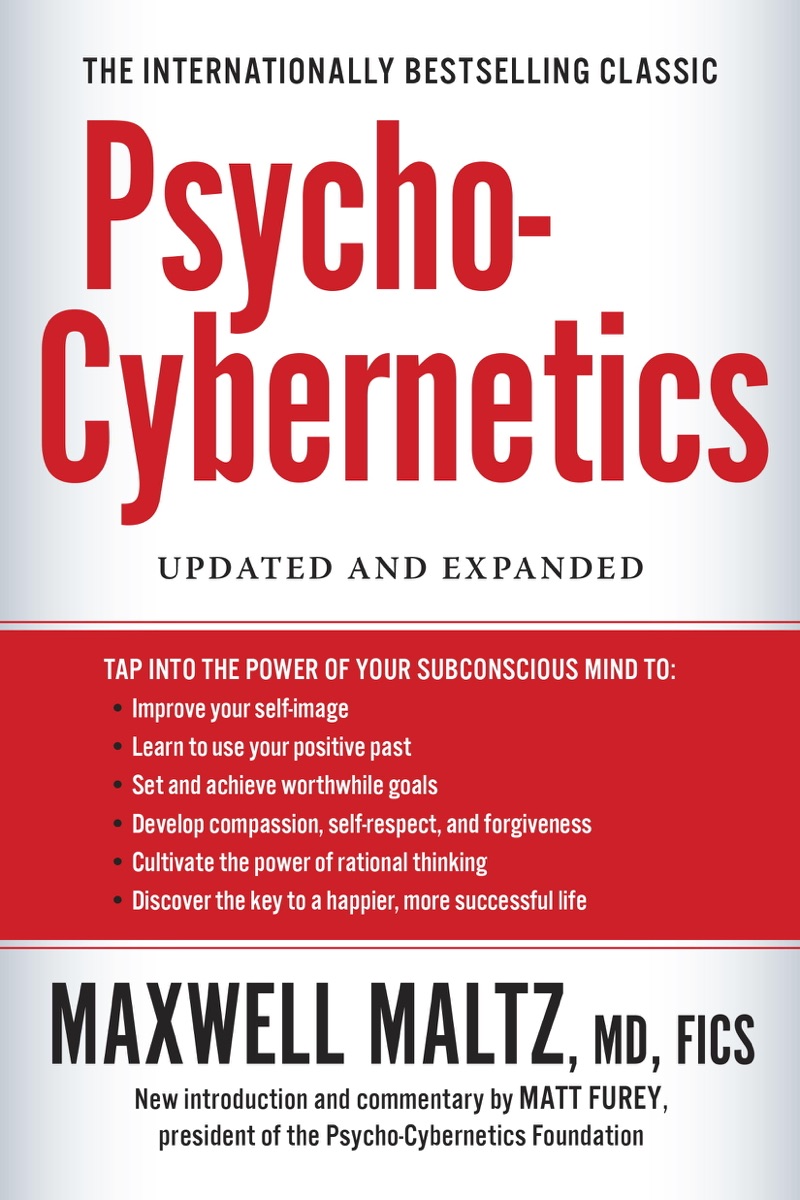
Psycho-Cybernetics
Maxwell Maltz
My take
Psycho-Cybernetics helped me see that lasting change is not only a matter of trying harder. We act from the picture we carry of ourselves, often without noticing how old or inaccurate that picture has become. Maltz’s most useful idea is that the mind behaves like a goal-seeking system: give it a clear direction, rehearse the experience, learn from the result, and let repetition make the unfamiliar feel normal. The book is not an argument for pretending. It is an invitation to stop treating yesterday’s evidence as the limit of who you can become.
Core insight 1: Your self-image quietly sets the ceiling
We rarely make decisions from a neutral view of what is possible. We filter each opportunity through a picture of who we believe we are. If that picture says awkward, unlucky, or not ready, behavior starts obeying the label before reality gets a vote.
The self-image sets the boundaries of individual accomplishment. It defines what you can and cannot do. Expand the self-image and you expand the “area of the possible.” The development of an adequate, realistic self-image will seem to imbue the individual with new capabilities, new talents, and literally turn failure into success.
The ceiling can feel like a fact because we meet it repeatedly. But repetition may only prove that the same internal picture keeps producing the same response.
How to practice: Name one identity statement behind a result you want to change. Replace it with a specific, believable picture of how you would act in the next real situation, then rehearse that action for a few minutes each day.
Core insight 2: The mind responds to the picture it receives
The nervous system does not wait for a future event to begin practicing a response. Vivid imagination can create enough of the experience for the body to learn from it. This is why mental rehearsal can make a hard conversation, performance, or decision feel less foreign when it arrives.
Your nervous system cannot tell the difference between an imagined experience and a real experience. In either case, it reacts automatically to information that you give to it from your forebrain. Your nervous system reacts appropriately to what you think or imagine to be true.
The point is not to picture applause or a perfect ending. It is to make the desired behavior familiar enough that you can access it under pressure.
How to practice: Before an important moment, close your eyes and rehearse the process in detail. Picture the room, the first sentence, the difficult beat, and yourself responding with the calm behavior you want to make available.
Core insight 3: A clear target matters more than constant control
Trying to consciously manage every movement can make performance stiff. Once the target is clear and the skill has been practiced, more control is not always more useful. At some point, attention has to move from monitoring yourself to meeting the moment.
Skill in any performance whether it be in sports in playing the piano in conversation or in selling merchandise consists not in painfully and consciously thinking out each action as it is performed but in relaxing and letting the job do itself through you. Creative performance is spontaneous and ‘natural’ as opposed to self-conscious and studied.
Preparation and trust are partners. Practice builds the response, then relaxation gives it room to appear.
How to practice: Decide what a good process looks like before you begin. During the performance, keep your attention on the next external cue instead of evaluating how you look while doing it.
Core insight 4: Mistakes are information, not identity
A mistake is useful while it helps correct the next attempt. It becomes harmful when we keep replaying it until a past event turns into a permanent description of the person who made it.
Our errors, mistakes, failures, and sometimes even our humiliations, were necessary steps in the learning process. However, they were meant to be means to an end - and not an end in themselves. When they have served their purpose, they should be forgotten. If we consciously dwell on the error, or consciously feel guilty about the error and keep berating ourselves because of it, then - unwittingly - the error or failure itself becomes the “goal” that is consciously held in imagination and memory.
Reflection should change the next move. If it only keeps the failure vivid, it is no longer reflection. It is rehearsal for repeating it.
How to practice: After a miss, write three lines: what happened, what it taught you, and what you will try next. Keep the lesson and stop retelling the verdict.
Core insight 5: Accepted ideas can behave like instructions
Some of our strongest limits began as casual judgments from another person, or as conclusions we formed in one painful season. Repeated often enough, they stop sounding like opinions and start operating like commands.
It is no exaggeration to say that every human being is hypnotized to some extent either by ideas he has uncritically accepted from others or ideas he has repeated to himself or convinced himself are true. These negative ideas have exactly the same effect upon our behavior as the negative ideas implanted into the mind of a hypnotized subject by a professional hypnotist.
The way out starts with noticing the sentence. A belief is easier to question once you can hear its exact words.
How to practice: Listen for an automatic sentence that appears when you hesitate. Ask where it came from, what evidence contradicts it, and whether you would hand that same sentence to someone you care about.
Core insight 6: Happiness cannot stay on the deferred plan
It is easy to turn happiness into a reward for finally solving life. The problem is that life keeps producing another unfinished task, uncertain outcome, or reason to wait.
Happiness is a mental habit, a mental attitude, and if it is not learned and practiced in the present it is never experienced. It cannot be made contingent upon solving some external problem. When one problem is solved, another appears to take its place. Life is a series of problems. If you are to be happy at all, you must be happy - period! Not happy “because of”.
This does not deny ambition or difficulty. It means the ability to feel alive today cannot depend entirely on a future version of life cooperating.
How to practice: Notice the next sentence that begins, “I will feel better when…” Then choose one ordinary experience you can fully enter today without requiring that future condition to change.
Core insight 7: Confidence grows from experienced evidence
Intellectual understanding rarely changes behavior by itself. We trust what we have felt ourselves do, even when that experience began as careful rehearsal or one small successful attempt.
Our present state of self-confidence and poise is the result of what we have “experienced” rather than what we have learned intellectually.
Confidence is less convincing as a speech and more convincing as a memory. Small proof gives the self-image something real to update around.
How to practice: Make the next challenge small enough to produce one clean repetition. Record what you did, not how impressive it looked, and increase the difficulty only after the behavior begins to feel familiar.
The most useful shift in Psycho-Cybernetics is moving from self-judgment to self-correction. You do not have to defend the old picture or replace it with fantasy. You can give your mind better evidence, one repeated experience at a time.
Other reminders
You will act like the sort of person you conceive yourself to be.
Conscious effort inhibits and ‘jams’ the automatic creative mechanism.
You make mistakes. Mistakes don’t make you.
Get yourself a goal worth working for.
The individual who is actively engaged in a struggle, or in striving toward an important goal, does not come up with pessimistic philosophies concerning the meaninglessness or the futility of life.
You must have a clear mental picture of the correct thing before you can do it successfully.
Enjoyed this? You'll like Open Loops.
Every Thursday, I share what I’m learning about growth, work, and the long game. Join 3K+ readers.
You might also like