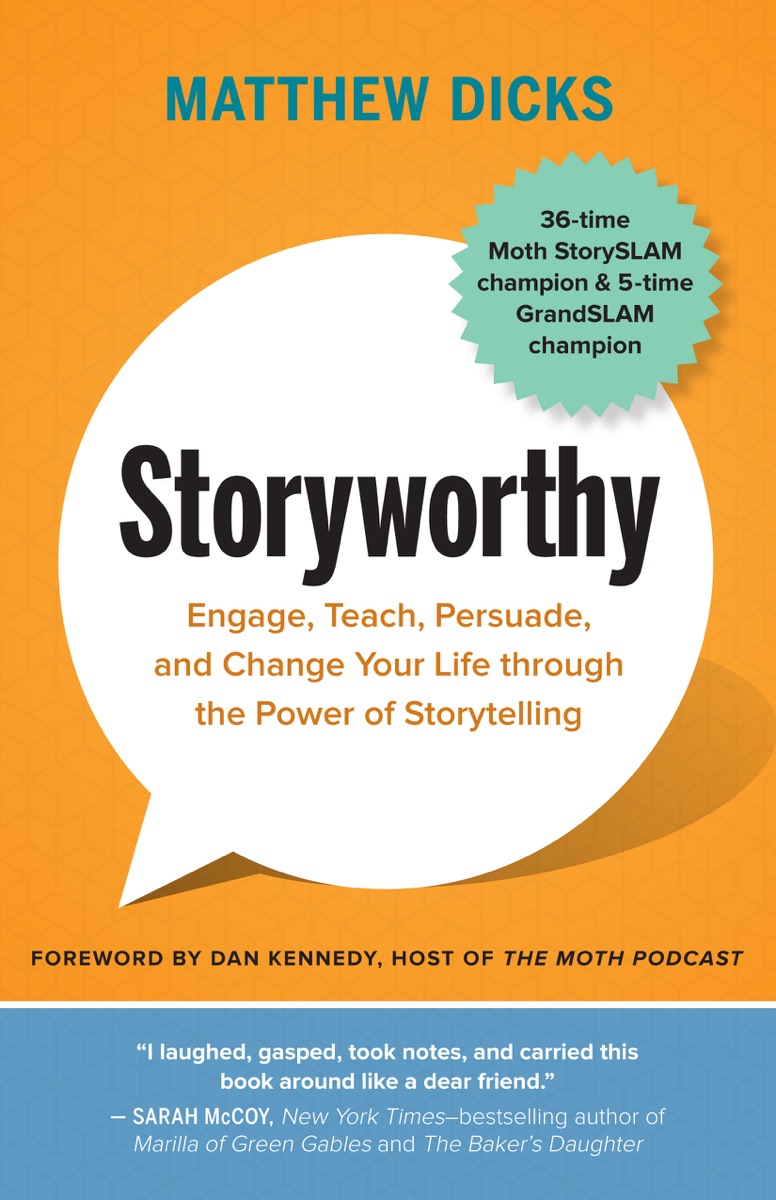
Storyworthy
Matthew Dicks
My take
Storyworthy changed the way I look for stories. I used to think the material had to be unusually dramatic before it was worth telling. Matthew Dicks makes a more useful case: the event can be ordinary, but something inside the person has to move. A great story is built around that small moment of change, then shaped so another person can feel it too. What stayed with me most is that storytelling is not only a performance skill. It is a way of paying closer attention to your own life.
Core insight 1: A story is a record of change
An event can be funny, surprising, or impressive without becoming a story. What gives it meaning is the difference between who the person was at the beginning and who they became by the end.
Your story must reflect change over time. A story cannot simply be a series of remarkable events. You must start out as one version of yourself and end as something new.
This makes transformation more important than spectacle. The external action holds attention, but the internal shift is what gives the action a reason to matter.
How to practice: Write one sentence for the person at the beginning and one for the person at the end. If the two sentences describe the same inner state, keep searching for what actually changed.
Core insight 2: The whole story serves one small moment
The heart of a story is often brief. A look, a sentence, or a realization changes the meaning of everything around it. The rest of the story exists to help the audience arrive at that moment with enough context to feel it.
Seek out the moments when you felt your heart move. When something changed forever, even if that moment seems minuscule compared to the rest of the story. That will be your five-second moment. Until you have it, you don’t have a story. When you find it, you’re ready to begin crafting your story.
This is a useful editing test. A detail belongs when it sharpens the five-second moment. If it only proves the day was interesting, it may be taking attention away from the point.
How to practice: Circle the exact beat where your understanding changed. Build toward it, then remove one detail that does not make that beat clearer, more surprising, or more moving.
Core insight 3: The ending tells you where to begin
A story becomes easier to shape once the ending is clear. The beginning should place us far enough from that final realization that we can feel the distance the person travels.
Simply put, the beginning of the story should be the opposite of the end. Find the opposite of your transformation, revelation, or realization, and this is where your story should start. This is what creates an arc in your story. This is how a story shows change over time. I was once this, but now I am this. I once thought this, but now I think this. I once felt this, but now I feel this.
Starting at the opposite also creates contrast without forcing drama. The audience sees the old belief first, so the new one can land as a real change rather than a closing statement.
How to practice: Finish the sentence, “By the end, I understood…” Then begin at the most recent moment when you genuinely believed, felt, or wanted the opposite.
Core insight 4: Story material hides in ordinary categories
Memory often freezes when the prompt is too broad. “Tell me a story” asks the mind to search an entire life at once. A specific category gives memory a door it can actually open.
It’s called First Last Best Worst. All you need to play is pen and paper. As you can see from the worksheet that follows, the top row of the page (the x-axis) is labeled with the words “First,” “Last,” “Best,” and “Worst,” along with a column labeled “Prompts.” Along the left side of the page (the y-axis), the prompts are listed. The prompts are the possible triggers for memories. What was your first kiss? What was your last kiss? What was your best kiss? What was your worst kiss? For each of these prompts, you fill in the word or words that indicate the answers to those questions. That’s it.
The power of the exercise is its simplicity. A few concrete words can bring back a room, a face, or a choice that would never appear under a general search for something “storyworthy.”
How to practice: Choose one prompt such as teacher, trip, meal, mistake, or goodbye. List your first, last, best, and worst version of it, then follow whichever answer carries the most emotional charge.
Core insight 5: Attention becomes a story-finding habit
Stories are easier to find when the search happens every day. A small daily practice trains the mind to notice moments it would otherwise file as unimportant and forget.
Miss one day, and you’ll allow yourself to miss two. Miss two days, and you’ll skip a week. Skip a week and you’re no longer doing your Homework for Life.
The practice is not valuable because every entry becomes a finished story. It is valuable because life stops passing as one undifferentiated block of time.
How to practice: At the end of each day, write one sentence about the moment most worth remembering. Keep it small. The goal is to build an index of lived moments, not to draft the story yet.
Core insight 6: Generating and judging need separate turns
Creative work tightens when every new thought is evaluated before it has room to lead anywhere. Early judgment favors the familiar because the unfamiliar rarely looks impressive in its first few seconds.
Essentially Crash & Burn is stream-of-consciousness writing. I like to think of it as dreaming on the end of your pen, because when it’s working well, it will mimic the free-associative thought patterns that so many of us experience while dreaming.
Free association is useful because memory is not organized like an outline. One image touches another, and the story may be waiting several links away from the thought that started the page.
How to practice: Set a ten-minute timer and keep the pen moving. Follow each new association without defending the previous one. Review the page only after the timer ends.
Core insight 7: An audience’s time creates a real obligation
When people give us their attention, they give us a piece of their life. A presentation is not successful because the speaker covered every slide. It succeeds when the audience receives something worth the time it cost them.
If you are conducting a one-hour meeting at your company, you have effectively stolen one hour from every person in the room. If there are twenty people in the room, your presentation is now the equivalent of a twenty-hour investment. It is therefore your responsibility to ensure that you do not waste the hour by reading from PowerPoint slides, providing information that could have been delivered via email, lecturing, pontificating, pandering, or otherwise boring your audience. You must entertain, engage, and inform. Every single time.
That standard changes preparation. The question stops being “What do I want to say?” and becomes “What deserves this many hours of human attention?”
How to practice: Multiply the length of your next meeting by the number of people attending. Then cut anything that could have been sent as a note and protect the moments that require people to be present together.
Storyworthy makes storytelling feel less like searching for extraordinary experiences and more like noticing the ordinary ones properly. The craft begins by finding the moment that changed you, then respecting it enough to remove everything that gets in its way.
Other reminders
Let me say it again: Every great story ever told is essentially about a five-second moment in the life of a human being, and the purpose of the story is to bring that moment to the greatest clarity possible.
So, regardless of how intriguing or compelling your current idea may be, you must release it immediately when a new idea comes crashing in, even if your new idea seems decidedly less compelling than the original one.
This is the magic of the present tense. It creates a sense of immediacy.
Rule #2: You must not judge any thought or idea that appears in your mind.
Rule #1: You must not get attached to any one idea.
The excuses became part of a playlist of lies that was perpetually cued up in my head and fell instantly from my lips.
Enjoyed this? You'll like Open Loops.
Every Thursday, I share what I’m learning about growth, work, and the long game. Join 3K+ readers.
You might also like