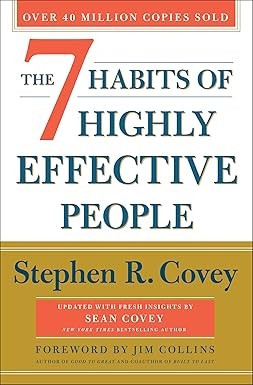
The 7 Habits of Highly Effective People
Stephen Covey
My take
Most people know this book by reputation and assume they already know what’s in it. I did too. But when I actually read it, what stuck was something very specific: the Circle of Influence. It’s the simplest concept in the book, and it became a daily tool for me. When something bothers me, when I’m frustrated or stuck, I ask one question: is this in my circle of influence? If yes, I work on it. If no, I let it go. Covey’s bigger ideas about character over personality, about private victories before public ones, those landed too. But it’s the Circle of Influence I return to almost daily. One framework that makes everything else easier to see. Underneath the business language is a philosophy about character, integrity, and the difference between being busy and being effective. Covey’s core argument: who you are matters more than what you know or what techniques you use.
Core insight 1: Character over personality
This is the foundational idea of the entire book. Most self-improvement focuses on techniques, tactics, and communication tricks. Covey calls this the Personality Ethic. But real effectiveness comes from the Character Ethic: principles like integrity, humility, patience, and courage that you build into who you are, not just how you present yourself.
The glitter of the Personality Ethic, the massive appeal, is that there is some quick and easy way to achieve quality of life, personal effectiveness and rich, deep relationships with other people, without going through the natural process of work and growth that makes it possible.
The most important ingredient we put into any relationship is not what we say or what we do, but what we are.
You can fake personality. You cannot fake character. And people can always tell the difference.
How to practice: When you notice yourself reaching for a communication technique or persuasion tactic, pause. Ask whether the issue is really about technique or about who you’re being. If you want to be trusted, be trustworthy. If you want respect, be respectable. Start from the inside out.
Core insight 2: The Circle of Influence
Covey divides everything in your life into two circles. The Circle of Concern holds everything you worry about: the economy, other people’s behavior, global events. The Circle of Influence holds what you can actually do something about: your own actions, responses, and commitments.
Proactive people focus their efforts in the Circle of Influence. They work on the things they can do something about. The nature of their energy is positive, enlarging and magnifying, causing their Circle of Influence to increase.
The ability to subordinate an impulse to a value is the essence of the proactive person.
Reactive people spend their energy in the Circle of Concern, complaining about things they cannot change. Proactive people shrink toward their Circle of Influence and, paradoxically, that circle grows over time.
How to practice: When you feel frustrated, ask one question: “Is this in my Circle of Influence?” If yes, act. If no, let it go. This single filter eliminates most of the noise in your head. The weather, someone else’s opinion, traffic: all outside your circle. Your response, your effort, your attitude: always inside it.
Core insight 3: Begin with the end in mind
Everything is created twice. First in the mind, then in reality. If you don’t consciously design the first creation, someone else will design it for you, through their agendas, their expectations, their priorities.
It’s incredibly easy to get caught up in an activity trap, in the busyness of life, to work harder and harder at climbing the ladder of success only to discover it’s leaning against the wrong wall.
We are either the second creation of our own proactive design, or we are the second creation of other people’s agendas, of circumstances, or of past habits.
You can be incredibly busy and incredibly effective at the same time. But if the ladder is leaning against the wrong wall, every step gets you to the wrong place faster.
How to practice: Write a personal mission statement. Not a corporate exercise. A genuine attempt to articulate what matters to you, how you want to show up, and what you want your life to be about. Revisit it regularly. It becomes your compass when the noise gets loud.
Core insight 4: Schedule your priorities
Most people prioritize their schedule. Covey flips it: schedule your priorities. The difference is everything.
The key is not to prioritize what’s on your schedule but to schedule your priorities. And this can best be done in the context of the week.
You have to decide what your highest priorities are and have the courage, pleasantly, smilingly, nonapologetically, to say “no” to other things. And the way you do that is by having a bigger “yes” burning inside.
Covey’s Quadrant II (important but not urgent) is where the real work lives: building relationships, long-term planning, health, learning, creative work. These things never scream for your attention, so they get buried under urgent trivia unless you protect time for them deliberately.
How to practice: At the start of each week, identify your top priorities across all your roles (professional, personal, health, relationships). Block time for these first. Everything else fits around them. Saying “no” is only hard when you don’t have a clear “yes.”
Core insight 5: Seek first to understand
Most people listen to respond, not to understand. They’re already forming their reply while the other person is still talking. Covey argues this is the single biggest failure in human communication.
We see the world, not as it is, but as we are, or, as we are conditioned to see it. When we open our mouths to describe what we see, we in effect describe ourselves, our perceptions, our paradigms.
No one can persuade another to change. Each of us guards a gate of change that can only be opened from the inside.
The real beginning of influence is when the other person feels genuinely understood by you. Not agreed with. Understood. That’s when trust opens and real conversation begins.
How to practice: In your next important conversation, try to restate the other person’s position before sharing yours. Not parroting their words, but articulating their perspective so well that they say “yes, exactly.” You’ll be surprised how rarely this happens and how powerful it is when it does.
Core insight 6: Between stimulus and response is freedom
Covey borrows this from Viktor Frankl and builds his entire framework on it. Between what happens to you and how you react, there is a gap. In that gap lives your freedom to choose.
It’s not what happens to us, but our response to what happens to us that hurts us.
We are not our feelings. We are not our moods. We are not even our thoughts. The very fact that we can think about these things separates us from them and from the animal world.
This is the most empowering idea in the book. You are not your reactions. You have the ability to observe your own thinking, question your own patterns, and choose a different response. That capacity is uniquely human.
How to practice: When you feel a reactive impulse (anger, defensiveness, blame), don’t suppress it. Just notice the gap before you act on it. In that gap, ask: “What response would I be proud of tomorrow?” Over time, the gap gets wider and your choices get better.
Core insight 7: Sharpen the saw
The final habit is about renewal. You cannot keep producing without investing in your capacity to produce. Covey calls this the P/PC Balance: Production vs. Production Capability.
Remember, to learn and not to do is really not to learn. To know and not to do is really not to know.
Our most important financial asset is our own capacity to earn. If we don’t continually invest in improving our own PC, we severely limit our options.
This applies to every dimension: physical (exercise, nutrition, rest), mental (reading, learning, creating), emotional (relationships, empathy, service), and spiritual (values, meditation, purpose). Neglect any one of these and the others start to suffer.
How to practice: Build renewal into your weekly rhythm, not as a reward for hard work, but as the foundation that makes hard work sustainable. Exercise, read, connect with people you care about, spend time in reflection. These are not luxuries. They are the maintenance that keeps everything else running.
The 7 Habits is a book about being effective, not just productive. The difference matters. Productivity is about output. Effectiveness is about alignment: making sure your effort matches your values, your ladder leans against the right wall, and your character can support the weight of whatever you’re building. Everything starts from the inside out.
Other reminders
We are what we repeatedly do. Excellence, then, is not an act, but a habit.
The ability to subordinate an impulse to a value is the essence of the proactive person.
If we want to make significant, quantum change, we need to work on our basic paradigms.
Dependent people need others to get what they want. Independent people can get what they want through their own effort. Interdependent people combine their own efforts with the efforts of others to achieve their greatest success.
Enjoyed this? You'll like Open Loops.
Every Thursday, I share what I’m learning about growth, work, and the long game. Join 3K+ readers.
You might also like