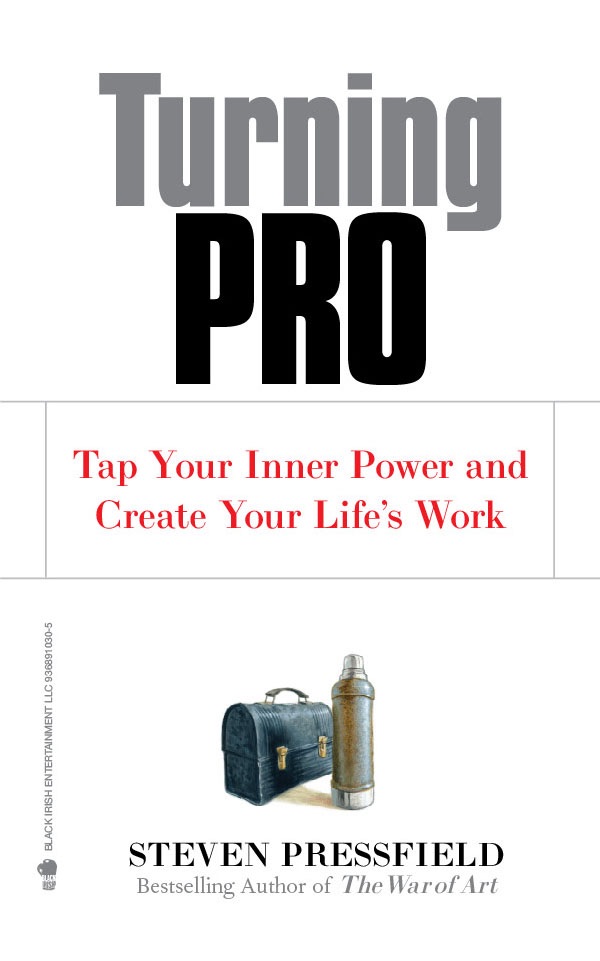
Turning Pro
Steven Pressfield
My take
I used to think the gap between wanting to make something and actually making it was mostly about time, talent, or the right plan. Turning Pro gave me a less comfortable answer: the gap is often identity. The amateur protects the fantasy of what they might do. The professional builds habits around what they have chosen to do, then returns tomorrow whether today felt inspired or flat. What stayed with me is that turning pro is not a promotion anyone gives you. It is the moment you stop negotiating with the work.
Core insight 1: Professionalism starts as an identity
The amateur and the professional can have the same ambition, tools, and fear. The difference is what each person treats as normal. One waits for the mood to arrive. The other expects to show up before the mood does.
The difference between an amateur and a professional is in their habits. An amateur has amateur habits. A professional has professional habits.
This is useful because identity becomes visible in the calendar. You do not need to declare yourself a professional. Your repeated behavior does it for you.
How to practice: Pick one small behavior that would be ordinary for the professional version of you. Put it on the calendar at the same time for the next ten working days, and keep the appointment even when the session is mediocre.
Core insight 2: Tomorrow protects the fantasy
A plan can feel productive while keeping the work safely imaginary. As long as the real attempt begins tomorrow, today’s self never has to face the possibility of being clumsy, rejected, or ordinary.
The sure sign of an amateur is he has a million plans and they all start tomorrow.
The hidden payoff of delay is not more preparation. It is protection. The fantasy stays perfect because reality never gets a chance to touch it.
How to practice: Reduce the next move until it can be completed today. Not plan the chapter, write one paragraph. Not design the offer, send one honest note to someone it could help.
Core insight 3: A shadow career looks close enough to feel safe
Some detours are not random. They copy the shape of the work we actually want while removing the part that scares us. We stay near the arena, useful to people inside it, without risking being seen in it ourselves.
Sometimes, when we’re terrified of embracing our true calling, we’ll pursue a shadow calling instead. That shadow career is a metaphor for our real career. Its shape is similar, its contours feel tantalizingly the same. But a shadow career entails no real risk. If we fail at a shadow career, the consequences are meaningless to us.
That is why a respectable path can still feel off. The problem may not be that it is bad. It may be that it is close enough to your real work to keep you from doing it.
How to practice: Ask what your current work resembles. Then name the version that carries more personal risk, ownership, and meaning. Give that version one protected hour this week.
Core insight 4: Commitment needs a physical address
Creative work becomes easier to enter when the body recognizes the setting. The same chair, the same desk, and the same hour become a signal: this is where the work happens.
When we convene day upon day in the same space at the same time, a powerful energy builds up around us. This is the energy of our intention, of our dedication, of our commitment.
Routine is not the enemy of creativity. It is the structure that lets creativity stop fighting for a place in your day.
How to practice: Choose a repeatable time and place for your most important work. Make the start ritual simple enough to survive a bad morning: sit down, remove the phone, open the file, begin.
Core insight 5: The present is where the work can hurt
The past offers explanations. The future offers possibility. Both can become more attractive than the present because neither asks us to make something imperfect right now.
The payoff of living in the past or the future is you never have to do your work in the present.
This is a sharp way to notice avoidance. If I am rehearsing what went wrong or imagining what could go right, I may be doing everything except the part that can change either one.
How to practice: When you catch yourself replaying or forecasting, write down the smallest action available in the next fifteen minutes. Do only that before deciding what comes next.
Core insight 6: A career becomes a practice when rewards stop leading
External rewards are real, but they are unreliable fuel. If the work only feels worthwhile when it brings attention, money, or approval, every quiet season begins to look like evidence that you should stop.
When we do the work for itself alone, our pursuit of a career (or a living or fame or wealth or notoriety) turns into something else, something loftier and nobler, which we may never even have thought about or aspired to at the beginning. It turns into a practice.
A practice has a different relationship with time. The point is not to finish proving yourself. The point is to keep becoming someone capable of better work.
How to practice: Define one standard you control completely, such as hours practiced, drafts completed, or conversations started. Review that measure before looking at likes, sales, or applause.
Core insight 7: Depth is a form of resistance to Resistance
Distraction is not always a lack of discipline. Sometimes it is a strategy for staying shallow enough that the work cannot test us. Depth removes the exits.
Resistance hates two qualities above all others: concentration and depth. Because when we work with focus and we work deep, we succeed.
Focused work is uncomfortable because it makes the stakes real. It also gives us the only evidence that weakens self-doubt: a body of work we can point to.
How to practice: Create one daily block with a single outcome and no switching. Stop when the block ends, not when discomfort begins.
Turning pro is less dramatic than it sounds. It is a quiet decision, renewed through ordinary habits, to stop asking the work for permission and start giving it your attention.
Other reminders
Turning pro is free, but it’s not easy. You don’t need to take a course or buy a product. All you have to do is change your mind.
Turning pro is like kicking a drug habit or stopping drinking. It’s a decision, a decision to which we must re-commit every day.
The amateur tweets. The pro works.
When we turn pro, we stop running from our fears. We turn around and face them.
The professional knows when he has fallen short of his own standards. He will murder his darlings without hesitation, if that’s what it takes to stay true to the goddess and to his own expectations of excellence.
The clash is epic and internal, between the ego and the Self, and the stakes are our lives.
Enjoyed this? You'll like Open Loops.
Every Thursday, I share what I’m learning about growth, work, and the long game. Join 3K+ readers.
You might also like