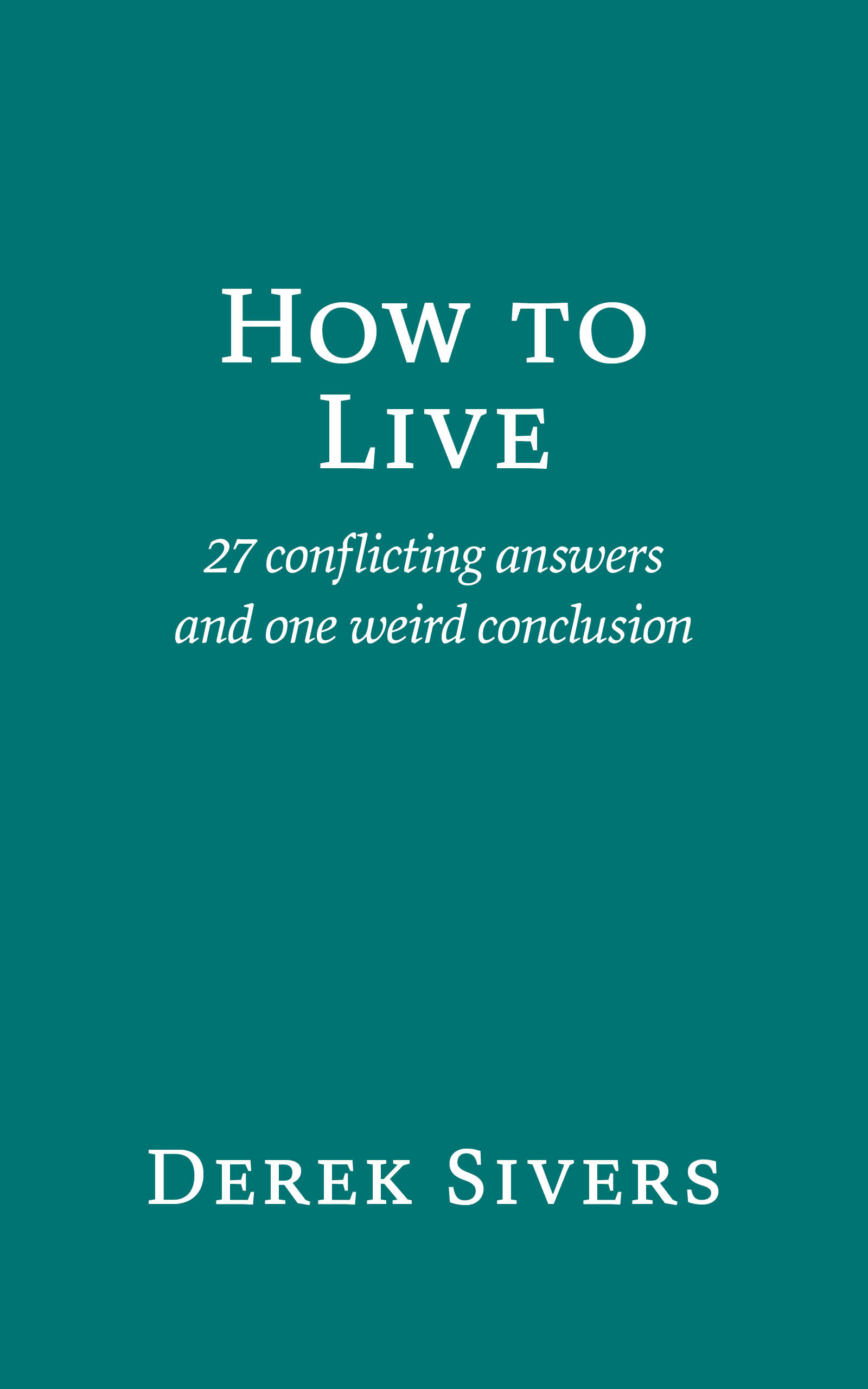
How to Live
Derek Sivers
My take
This is the book I keep returning to, and each pass teaches me something different. Sivers doesn’t write a book of advice, he writes 27 books, each one a different and confidently-argued answer to the question “how to live.” Be independent. Commit. Fill your senses. Do nothing. Make memories. Master something. Let randomness rule. Pursue pain. Get rich. Reinvent yourself. Love. Create. Each chapter is internally consistent and feels like the right answer while you’re reading it. Then the next chapter contradicts the last one, also persuasively. By the end you realise the book itself is the lesson: there is no single right way, and the wisdom is in the balance. Sivers writes in his trademark stripped-down prose, no fat, no throat-clearing, every line a punch. It reads more like a constitution than a self-help book. I keep it on the shelf I reach for when something is off and I can’t name what.
Core insight 1: Commitment is what makes any choice the best choice
Sivers names a trap I had been living in for years without seeing it: the search for the best option. The best partner, the best city, the best career. He flips it. No choice is inherently the best. What makes something the best choice is your commitment to it. The dedication you pour in is what creates the value. Standing at the edge of every option, refusing to choose, you stay perpetually average at all of them.
But seeking the best is the problem. No choice is inherently the best. What makes something the best choice? You. You make it the best through your commitment to it. Your dedication and actions make any choice great.
When you commit to one outcome, you’re united and sharply focused. When you sacrifice your alternate selves, your remaining self has amazing power.
How to practice: Pick the thing you’ve been hedging on. Stop comparing it to the alternatives you didn’t choose. Pour everything into it for long enough that the question of whether it was the best becomes irrelevant.
Core insight 2: Pick one thing and go deep for the rest of your life
In a culture that worships range, Sivers makes the case for the opposite. Mastery is the one form of status nobody can buy, inherit, or steal. It compounds quietly. The deeper you go, the more you see what others miss, and the more interesting the path becomes.
Pick one thing and spend the rest of your life getting deeper into it.
Mastery is the best goal because the rich can’t buy it, the impatient can’t rush it, the privileged can’t inherit it, and nobody can steal it. You can only earn it through hard work. Mastery is the ultimate status.
How to practice: Notice the thing you keep returning to even when nobody’s watching. That’s your one thing. Stop apologising for it. Go ten years deeper than feels reasonable.
Core insight 3: Turn your experiences into stories
This one rewired how I think about memory. Your memories are not records, they are reconstructions, and the story you tell about an experience eventually becomes the only thing left of it. Sivers’ move: take that seriously. Shape your stories with intention. Make them entertaining enough that people ask you to retell them. Each retelling is a vote for that memory’s survival.
Turn your experiences into stories. A story is the remains of an experience. Make your stories entertaining, so people like to hear them. By telling good stories, your memories can last longer, because people will echo them back to you occasionally, or ask you to tell them again.
Your memories are a mix of fact and fiction. Your story about an experience overwrites your memory of the actual experience. So use this in your favor. Re-write your past. Embellish adventures. Disempower trauma. Re-write your stories into whatever works for you. Remember only what you want to remember. You have the right to reframe.
How to practice: Pick an experience that shaped you. Write it down once. Then ask: is this the version I want to carry? If not, rewrite it. Tell the new version out loud until it sticks.
Core insight 4: Win by not losing
The cleanest mental model for risk I’ve ever read. Most success isn’t the result of brilliant offence, it’s the result of avoiding catastrophic mistakes. The investor who survives. The athlete who finishes. The artist who keeps shipping. Sivers strips it to a sentence: avoiding failure is the path to success.
Avoiding failure leads to success. The winner is usually the one who makes the least mistakes. This is true in investing, extreme skiing, business, flying, and many other fields. Win by not losing.
Most of eating healthy is just avoiding bad food. Most of being right is just not being wrong. To have good people in your life, just cut out the bad ones.
How to practice: Before optimising for what to do, audit what to stop doing. The asymmetric wins live in subtraction.
Core insight 5: Die empty
The chapter on creating is the one I bookmark most. Sivers’ frame: every idea you don’t get out of your head dies with you. The point of being alive is not to acquire more ideas, it’s to release them. The work is the gift. The creator’s job is to die with nothing left inside.
The way to live is to create. Die empty. Get every idea out of your head and into reality.
Let the deadline of death drive you. Create until your last breath. Let your last spark of life go into your work. Die empty, so death takes only a corpse. When you’re gone, your work shows who you were. Not your intentions. Not what you took in. Only what you put out.
How to practice: What’s the idea you’ve been polishing in your head for months? Ship the worst possible version of it this week. You can improve something bad. You can’t improve nothing.
Core insight 6: The world doesn’t need more audience
Sivers reframes work itself. Work isn’t a job. Work is whatever you want to change. The world has plenty of observers and critics. What it lacks is people who see something broken and quietly fix it. If you went through life observing without changing anything, what did you actually do?
Change the world as much as you can. All your learning and thinking is wasted if you don’t take action. People try to explain the world, but the real point is to change the world. If you go through life without changing anything, what have you done? Just observed?! The world doesn’t need more audience. The world needs changing. What’s broken needs fixing. What’s OK needs improving. What’s harmful needs destroying.
How to practice: Look at what bothers you most about your immediate environment. Don’t write about it. Don’t post about it. Just change it. Start with the smallest version you can complete this week.
Core insight 7: Honesty is what makes connection possible
The chapter on love and connection turned out to be the one that landed hardest for me. Sivers makes a quiet but devastating argument: every time you soften the truth to make someone comfortable, you make real connection a little less possible. They never meet the actual you. You never feel actually loved.
The hardest part of connecting with someone is being honest. If you say what you think someone wants to hear, you’re preventing a real connection. Manners are shallow. Honesty is deep. Always tell the real truth, or they’ll never know the real you, so you’ll never really feel loved.
If you have feelings for someone, and you don’t let that person know, you’re lying with your silence. Be direct. It saves so much trouble and regret.
How to practice: Notice the next time you smooth a true thing into a polite thing. Try the true version instead. Watch what happens to the room.
Core insight 8: Balance is the meta-answer
The book’s final chapter is the punchline that recasts everything before it. After 26 confident, contradictory answers, Sivers lands here: virtue is in the balance between extremes. Even your strengths become weaknesses if pushed too far. The way to live is not to find the one right answer. It is to balance the many.
Virtue is in the balance between extremes. Between the insecure and the egomaniac: confidence. Between the uptight and the clown: grace. Between the coward and the daredevil: courage. Between selfishness and sacrifice: generosity. So, the way to live is to balance everything.
By balancing everything in your life, you postpone nothing. You won’t postpone happiness, dreams, love, or expression. You could die happy at any time. Balancing everything is how to live.
How to practice: Make a list of the things you over-invest in and the things you ignore. The list itself is the prescription. Move energy from one column to the other until the wheel rolls smoothly.
This is the only book I have read where every chapter contradicts the others and the whole still feels coherent. Sivers has stripped a lifetime of thinking into a slim volume that you can finish in an afternoon and unpack for a decade. Read it once. Then read it whenever something in your life feels off and you can’t name why.
Other reminders
Many huge achievements are just the result of little actions done persistently over time.
Desire is the opposite of peace.
Actions often have the opposite of the intended result. People who try too hard to be liked are annoying. People who try too hard to be attractive are repulsive. People who try too hard to be enlightened are self-centered. People who try too hard to be happy are miserable.
Friends are great at the right distance. Just like you can’t read something if it’s pushed up against your face, or too far away, you should keep your friends at arm’s length, close but not too close.
Being independent means you can’t blame others. Decide everything is your fault. Whoever you blame has power over you, so blame only yourself.
Live where nothing is happening. Move to a quiet place with lots of nature and no ambition. Doing nothing is normal there. Walk and appreciate nature for hours a day. Your life and mind will be tranquil and serene.
The unintelligent jump to conclusions. The wise just observe. Wisdom comes from removing the junk, lies, and obstacles to clear thinking.
When you’re young, time goes slowly because everything is new. When you get older, time flies by, forgotten, because you’re not having as many new experiences. You need to prevent this. Monotony is the enemy. Novelty is the solution.
Since you can’t avoid problems, just find good problems. Happiness isn’t everlasting tranquility. Happiness is solving good problems.
Following your emotions is not freedom. Being free from following emotions is freedom.
Enjoyed this? You'll like Open Loops.
Every Thursday, I share what I’m learning about growth, work, and the long game. Join 3K+ readers.
You might also like