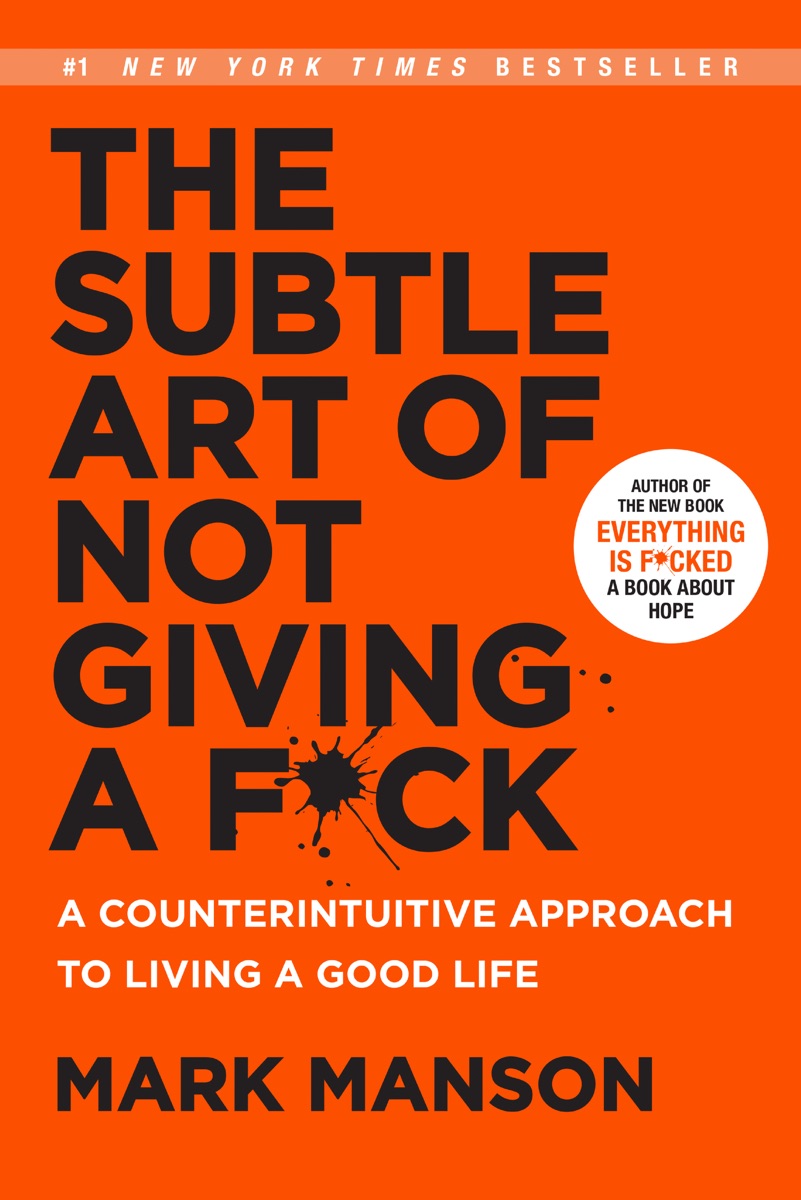
The Subtle Art of Not Giving a F*ck
Mark Manson
My take
The title makes this sound like a book about caring less. What stayed with me was almost the opposite. Manson’s point is that you are always caring about something, even when you pretend not to. The real choice is what deserves your attention, which problems are worth carrying, and which standards get to shape your life. That landed because it turns self-improvement away from chasing better feelings and toward choosing better values. A good life is not one where nothing bothers you. It is one where the things that bother you are connected to something you have consciously decided matters.
Core insight 1: Your attention is already making choices
Not caring is not a neutral position. Avoiding a decision still gives something else permission to decide for you: approval, comfort, comparison, or whatever feels loudest that day. The useful question is not whether you care too much. It is whether the things taking your energy have earned it.
Subtlety #3: Whether you realize it or not, you are always choosing what to give a fuck about.
How to practice: Look at the three things taking most of your mental energy this week. For each one, name the value underneath it. If you cannot name a value you respect, reconsider how much attention it deserves.
Core insight 2: Better values create better problems
Every direction comes with friction. More freedom creates uncertainty. Better relationships require harder conversations. Meaningful work exposes you to failure. The aim is not to remove problems but to choose values that produce problems you are willing to solve. That is a much more honest definition of progress than hoping life eventually becomes easy.
Our values determine the nature of our problems and the nature of our problems determines the quality of our lives.
How to practice: When you feel stuck, ask whether this is a bad problem or the natural cost of something you value. If it is the second, stop treating the discomfort as evidence that you chose wrongly.
Core insight 3: Chasing a feeling can reinforce its absence
The harder you insist that you must feel confident, happy, or certain, the more attention you give to the fact that you do not feel that way yet. This is the book’s sharpest paradox. Acceptance does not mean giving up. It means dropping the extra struggle created by arguing with the experience you are already having.
The desire for more positive experience is itself a negative experience. And, paradoxically, the acceptance of one’s negative experience is itself a positive experience.
How to practice: Name the feeling you are trying to get rid of. Let it be present for ten minutes without turning it into a verdict or a project. Then decide what action still makes sense with the feeling in the room.
Core insight 4: Responsibility is about agency, not blame
Responsibility can sound like admitting that everything was your fault. Manson makes a more useful distinction. You may not have chosen what happened, but the interpretation and response are still yours. That does not erase unfairness. It keeps unfairness from owning every decision that follows.
We don’t always control what happens to us, but we always control how we interpret what happens to us, as well as how we respond.
How to practice: Separate the cause of a problem from responsibility for the next move. You do not need to accept blame that is not yours in order to reclaim the part you can influence.
Core insight 5: Action can come before motivation
Waiting to feel ready gives motivation too much authority. Often the feeling arrives only after movement has created evidence that movement is possible. This changes the first step from a test of confidence into a way of generating it.
Action isn’t just the effect of motivation; it’s also the cause of it.
How to practice: Make the first action small enough that it does not require inspiration. Open the document, walk for five minutes, send the first sentence. Let motion produce the information that thinking cannot.
Core insight 6: Identity turns feedback into a threat
The more specific and precious an identity becomes, the more reality has the power to injure it. If you must be the smart one, confusion feels humiliating. If you must be the successful one, an ordinary setback feels existential. A lighter identity gives you room to learn without treating every correction as a collapse.
The more something threatens your identity, the more you will avoid it.
How to practice: Notice the feedback you are most tempted to dismiss. Ask what identity it threatens, then describe yourself in broader, more ordinary terms that leave room for being wrong.
Core insight 7: Commitment is built from rejection
Choosing one path means closing others, at least for now. That can feel like losing possibility, but endless possibility has its own cost: nothing receives enough time to become meaningful. Depth is created as much by what you keep refusing as by what you repeatedly choose.
The act of choosing a value for yourself requires rejecting alternative values.
How to practice: Pick one commitment you want to deepen. Write down the alternatives you will deliberately decline for the next season so your yes has enough space to become real.
This book is not permission to become indifferent. It is an invitation to become more deliberate about the values, problems, and commitments that receive your finite attention. Caring less is a side effect of caring more clearly.
Other reminders
Who you are is defined by what you’re willing to struggle for.
Emotions are simply biological signals designed to nudge you in the direction of beneficial change.
Not giving a fuck does not mean being indifferent; it means being comfortable with being different.
To not give a fuck about adversity, you must first give a fuck about something more important than adversity.
Being wrong opens us up to the possibility of change. Being wrong brings the opportunity for growth.
No matter where you go, there’s a five-hundred-pound load of shit waiting for you. And that’s perfectly fine. The point isn’t to get away from the shit. The point is to find the shit you enjoy dealing with.
Enjoyed this? You'll like Open Loops.
Every Thursday, I share what I’m learning about growth, work, and the long game. Join 3K+ readers.
You might also like