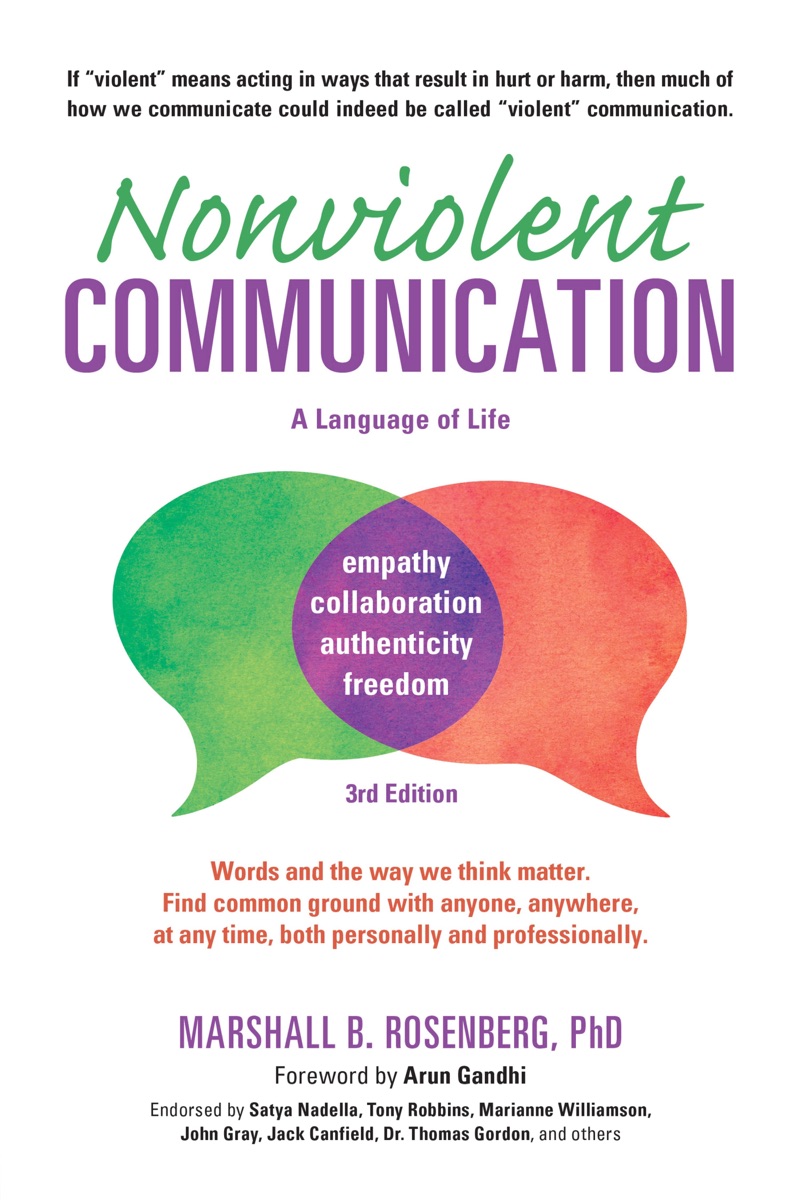
Nonviolent Communication
Marshall B. Rosenberg
My take
Most conflict changes shape when I stop asking who is right and start asking what each person is feeling and needing. Nonviolent Communication gave me a practical language for making that shift. Rosenberg separates observation from evaluation, feelings from accusations, needs from strategies, and requests from demands. What stayed with me is how much responsibility this requires. Compassion here asks for more than tolerating every behavior or avoiding disagreement. It means describing what happened without turning a person into a label, owning what is alive in me, and making enough room for both people to choose their response.
Core insight 1: A judgment hides the information we need
Labels feel efficient because they turn a complicated interaction into one clean conclusion. But calling someone selfish, careless, or difficult tells us very little about what happened. It replaces a specific observation with a fixed identity, which makes change harder for everyone involved.
Our attention is focused on classifying, analyzing, and determining levels of wrongness rather than on what we and others need and are not getting.
The more precise the observation, the more possible the conversation becomes. “You interrupted me twice” gives us something we can discuss. “You are disrespectful” gives the other person an identity to defend.
How to practice: When you notice a label, rewrite it as something a camera could have recorded. Include the concrete action, timing, or words, then leave your interpretation for a separate sentence.
Core insight 2: Feelings point toward needs
Feelings carry information about what matters to us. Anger may point toward respect, fear toward safety, and sadness toward connection or loss. When we treat the feeling as proof that another person is guilty, we miss the need underneath it.
At the core of all anger is a need that is not being fulfilled.
Naming the need changes the quality of attention. It moves the conversation away from prosecution and toward the conditions that could make life better.
How to practice: Complete two sentences before a difficult conversation: “I feel…” and “because I need…” Keep the second sentence free of another person’s name or behavior so the need remains something you can own.
Core insight 3: Responsibility begins with owning our inner response
Other people affect us, sometimes profoundly, but they do not fully author our thoughts, feelings, or behavior. When we say someone “made” us react, we give away the part of the experience where choice still exists.
We are dangerous when we are not conscious of our responsibility for how we behave, think, and feel.
Ownership leaves harm fully visible while keeping us connected to our agency afterward. That gives us more options than blame alone can provide.
How to practice: Replace “You made me feel…” with “When this happened, I felt…” Then name the need and the next action you are choosing for yourself.
Core insight 4: Anger is a signal before it becomes a strategy
Anger often arrives with a story about what is wrong with someone else. The story can feel convincing because it gives the energy a target. Rosenberg asks us to pause before turning that target into a plan.
Anger is a result of life-alienating thinking that is disconnected from needs. It indicates that we have moved up to our head to analyze and judge somebody rather than focus on what we are needing and not getting.
The anger still matters. Its value is in revealing a need, not in deciding what another person deserves.
How to practice: When anger rises, write the accusation exactly as it appears in your mind. Under it, list the values or needs being threatened. Speak from that second list when you are ready.
Core insight 5: Criticism sounds different when we listen for the appeal
A harsh message can contain two layers: the words being used and the unmet need trying to get through them. We can listen for the second layer without agreeing with the first, which gives us a way to understand the person without absorbing their judgment as truth.
All criticism, attack, insults, and judgments vanish when we focus attention on hearing the feelings and needs behind a message. The more we practice in this way, the more we realize a simple truth: behind all those messages we’ve allowed ourselves to be intimidated by are just individuals with unmet needs appealing to us to contribute to their well-being.
This is a demanding form of attention. It asks us to hear pain without immediately defending, correcting, or counterattacking.
How to practice: Before responding to criticism, make one private guess: “Are they feeling… because they need…?” You do not need to say the guess aloud. Use it to choose a response that addresses the human concern without accepting an unfair label.
Core insight 6: The reason behind compliance matters
Force can produce the visible behavior we want while damaging the relationship that behavior depends on. A person may comply because they fear punishment, want approval, or genuinely understand the request. Those outcomes look similar in the moment and create very different futures.
Two Questions That Reveal the Limitations of Punishment Two questions help us see why we are unlikely to get what we want by using punishment to change people’s behavior. The first question is: What do I want this person to do that’s different from what he or she is currently doing? If we ask only this first question, punishment may seem effective, because the threat or exercise of punitive force may well influence someone’s behavior. However, with the second question, it becomes evident that punishment isn’t likely to work: What do I want this person’s reasons to be for doing what I’m asking?
A request protects choice. The possibility of hearing no is what separates cooperation from control.
How to practice: Before making a request, ask whether you are willing to hear no without retaliation. If you are not, name the consequence or boundary clearly instead of presenting a demand as a choice.
Core insight 7: Caring for others can become emotional slavery
Sensitivity to other people’s feelings is valuable until it turns their emotional state into our permanent assignment. Trying to keep everyone happy creates resentment because the job has no finish line and no person can complete it.
In this stage, which I refer to as emotional slavery, we believe ourselves responsible for the feelings of others. We think we must constantly strive to keep everyone happy. If they don’t appear happy, we feel responsible and compelled to do something about it. This can easily lead us to see the very people who are closest to us as burdens.
Care becomes more sustainable when it is chosen instead of compelled. We can respond to someone’s pain while still recognizing that their feelings, needs, and choices belong to them.
How to practice: Notice one place where you are managing another adult’s mood. Ask what care you freely want to offer, what responsibility is theirs, and what boundary would let you stay connected without taking over.
Nonviolent Communication turns compassion into a discipline of attention: observe carefully, name what is alive, find the need, and make a clear request. Conflict remains, but it has less chance to turn people into enemies.
Other reminders
What I want in my life is compassion, a flow between myself and others based on a mutual giving from the heart.
All violence is the result of people tricking themselves into believing that their pain derives from other people and that consequently those people deserve to be punished.
peace cannot be built on the foundations of fear.
When we are in contact with our feelings and needs, we humans no longer make good slaves and underlings.
With every choice you make, be conscious of what need it serves.
Blaming and punishing others are superficial expressions of anger.
Enjoyed this? You'll like Open Loops.
Every Thursday, I share what I’m learning about growth, work, and the long game. Join 3K+ readers.
You might also like