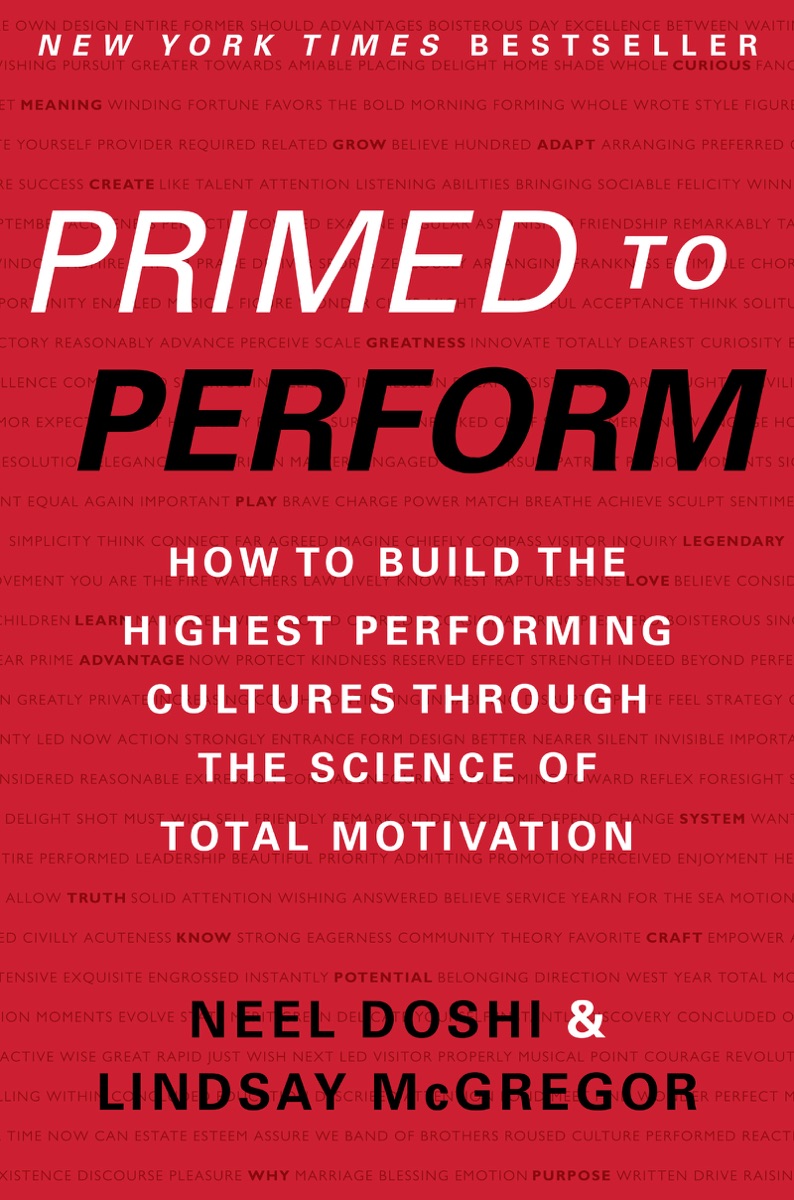
Primed to Perform
Neel Doshi & Lindsay McGregor
My take
A friend recommended this one, and I couldn’t put it down. Most companies get motivation completely wrong. They use bonuses, rankings, and pressure, thinking those are the levers that drive performance. Doshi and McGregor show why that backfires: those indirect motivators (emotional pressure, economic pressure, inertia) might get short-term compliance, but they destroy the kind of performance that actually matters. The book’s central framework, Total Motivation, splits motivation into six sources and makes you see that the only durable drivers are play, purpose, and potential. What hit me hardest was the distinction between tactical and adaptive performance. Tactical is following the plan. Adaptive is what happens when the plan breaks. And the whole point is that indirect motivators crush adaptive performance, which is the thing you need most when things get unpredictable. I’ve seen this in every startup I’ve worked with: the teams that experiment and think on their feet always outperform the ones running on fear and incentives.
Core insight 1: Why you work determines how well you work
This is the book’s thesis, distilled. The reason behind the work isn’t just a nice-to-have. It’s the primary predictor of performance quality. When someone works because the activity itself is interesting (play), because they believe in the outcome (purpose), or because the work builds toward something they care about (potential), they perform at a fundamentally different level than someone working out of guilt, reward-seeking, or habit.
To build a high-performing culture, you must first understand what drives peak performance in individuals. The answer sounds deceptively simple: why you work affects how well you work.
Total motivation is so fundamental to who we are as people that it can predict which marriages will be happy, whether you’ll lose weight on your new diet, which athletes will stick with their sports, and which students will stay in school.
The implications go far beyond the office. This framework applies to relationships, health, creativity. Anywhere you’re trying to sustain high performance over time, the motivation behind the effort is the variable that matters most.
How to practice: Pick one area of your life where performance feels inconsistent. Ask yourself honestly: am I doing this out of play, purpose, or potential? Or is it guilt, reward, or habit driving me? The answer usually explains the inconsistency.
Core insight 2: Tactical vs. adaptive performance
Most organizations only manage one type of performance: the ability to execute the plan. But the ability to diverge from the plan is equally important, and it’s the one that separates great teams from decent ones.
If tactical performance is a person’s ability to execute the plan, then adaptive performance is a person’s or organization’s ability to diverge from the plan. They are opposites.
Many leaders forget that there are actually two types of performance, both important yet mutually opposed. Most organizations manage tactical performance. But adaptive performance is just as important.
This is why so many well-run companies still fail when conditions shift. They optimized for execution but never built the muscle to adapt. Tight processes and strict KPIs can actually make a team less capable of handling the unexpected, because people stop thinking and start complying.
How to practice: Look at your team’s workflows. Where have you optimized so heavily for consistency that people no longer feel permission to experiment? That’s where adaptive performance is being quietly killed.
Core insight 3: The Cobra Effect is everywhere
In colonial India, the British put a bounty on dead cobras to reduce the population. It worked, until people started breeding cobras just to collect the bounty. When the government ended the program, breeders released the snakes. The cobra population ended up higher than before. This is what happens when you incentivize the metric instead of the outcome.
Emergence occurs when the individual components of a collective are able to organize themselves into a system that is far more complicated than the sum of its parts. These systems are almost always self-organized and have incredible levels of adaptive performance.
The same dynamic plays out in companies constantly. Sales targets that reward closing deals over solving problems. Performance reviews that reward visibility over impact. Every time you attach a reward to a proxy metric, you’re inviting people to game the proxy and ignore the actual goal.
How to practice: Audit your incentive structures. For each reward or metric, ask: if someone optimized purely for this number, would the outcome actually be what I want? If not, the incentive is broken.
Core insight 4: Play is the most powerful driver
Play doesn’t mean fun. It means the work itself is the motive. When someone is engaged because the activity is inherently interesting, challenging, or stimulating, that’s the play motive. And it’s the closest motivator to the work itself, which makes it the strongest predictor of performance.
For your people to feel play at work, the motive must be fueled by the work itself, not the distraction. Because the play motive is created by the work itself, play is the most direct and most powerful driver of high performance.
This reframes a lot of what companies call “culture.” Free snacks and ping pong tables aren’t play. They’re distractions from work that isn’t engaging. Real play comes from designing the work itself to be exploratory, challenging, and interesting.
How to practice: Instead of adding perks around work, redesign the work. Give people problems to solve, not just tasks to complete. Build in space for experimentation. The goal isn’t to make work more fun, it’s to make the work itself the reason people show up.
Core insight 5: Strategy is focus, culture is agility
Most leaders treat strategy and culture as separate conversations. Doshi and McGregor argue they’re two halves of the same thing. Strategy tells you where to aim. Culture determines whether you can adapt when the aim needs to shift.
Strategy helps us focus all our energy on a few critical targets. It is a force of strength. Culture, on the other hand, allows us to react to the unpredictable. It is a force of agility. Together, they create a complete view of performance.
A company with great strategy and weak culture will execute well until conditions change, then fall apart. A company with great culture and no strategy will adapt beautifully to nothing in particular. You need both. The mistake is treating culture as the soft stuff that happens after the strategic plan is locked.
How to practice: When building your next quarterly plan, don’t just set targets. Ask: does our culture actually support the kind of performance these targets require? If you’re asking people to innovate but your culture runs on compliance, the plan is already broken.
Core insight 6: Your beliefs about people become self-fulfilling
Leaders who believe they have underperformers on their team create underperformers. The Pygmalion effect is well-documented: your expectations of someone shape their behavior more than their raw capability does.
The idea that a leader’s expectation can become a self-fulfilling prophecy has been demonstrated in so many experiments that the phenomenon has been given its own name: the Pygmalion effect.
Believing you have underachievers on your team creates underachievers.
This one should make every manager uncomfortable. The way you see your team isn’t neutral observation. It’s an active input into their performance. When you treat someone like they’re capable, they rise. When you treat someone like a liability, they become one.
How to practice: Notice the story you tell yourself about each person on your team. If the story is negative, run an experiment: act as if they’re fully capable for two weeks and see what changes. More often than not, the shift starts with you.
Core insight 7: Purpose only works when you can see the impact
Believing in the mission isn’t enough. People need to see the direct connection between their work and the outcome it creates. When that line of sight gets blocked, purpose drains out, no matter how noble the company’s stated values are.
You feel the purpose motive in the workplace when your values and beliefs align with the impact of the work.
Inability to see the impact of your work can significantly affect ToMo.
This is why large organizations struggle with motivation even when their mission is compelling. The further someone sits from the end user, the harder it is to feel purpose. It’s not that people don’t care. It’s that the feedback loop between effort and impact has too many layers.
How to practice: Create direct lines between your team and the people they serve. Let engineers sit in on customer calls. Let ops people see how their work shows up in the final product. Purpose isn’t a poster on the wall, it’s a feedback loop.
This book changed how I think about every team I’ve worked with and every culture I’ve helped build. The framework is clean, the evidence is thorough, and the implications go well beyond the office. If you manage people, design incentives, or care about why some teams thrive while others just function, this one will sharpen how you think about all of it.
Other reminders
If you remember only one thing from Primed to Perform, it should be that a culture that inspires people to do their jobs for play, purpose, and potential creates the highest and most sustainable performance.
Adaptive performance is most critical with Customer Service.
Strategy helps us focus all our energy on a few critical targets. It is a force of strength. Culture, on the other hand, allows us to react to the unpredictable. It is a force of agility.
Emergence occurs when the individual components of a collective are able to organize themselves into a system that is far more complicated than the sum of its parts.
Apple Stores produce more sales per square foot than any other retailer in the United States, including luxury stores like Tiffany.
Enjoyed this? You'll like Open Loops.
Every Thursday, I share what I’m learning about growth, work, and the long game. Join 3K+ readers.
You might also like