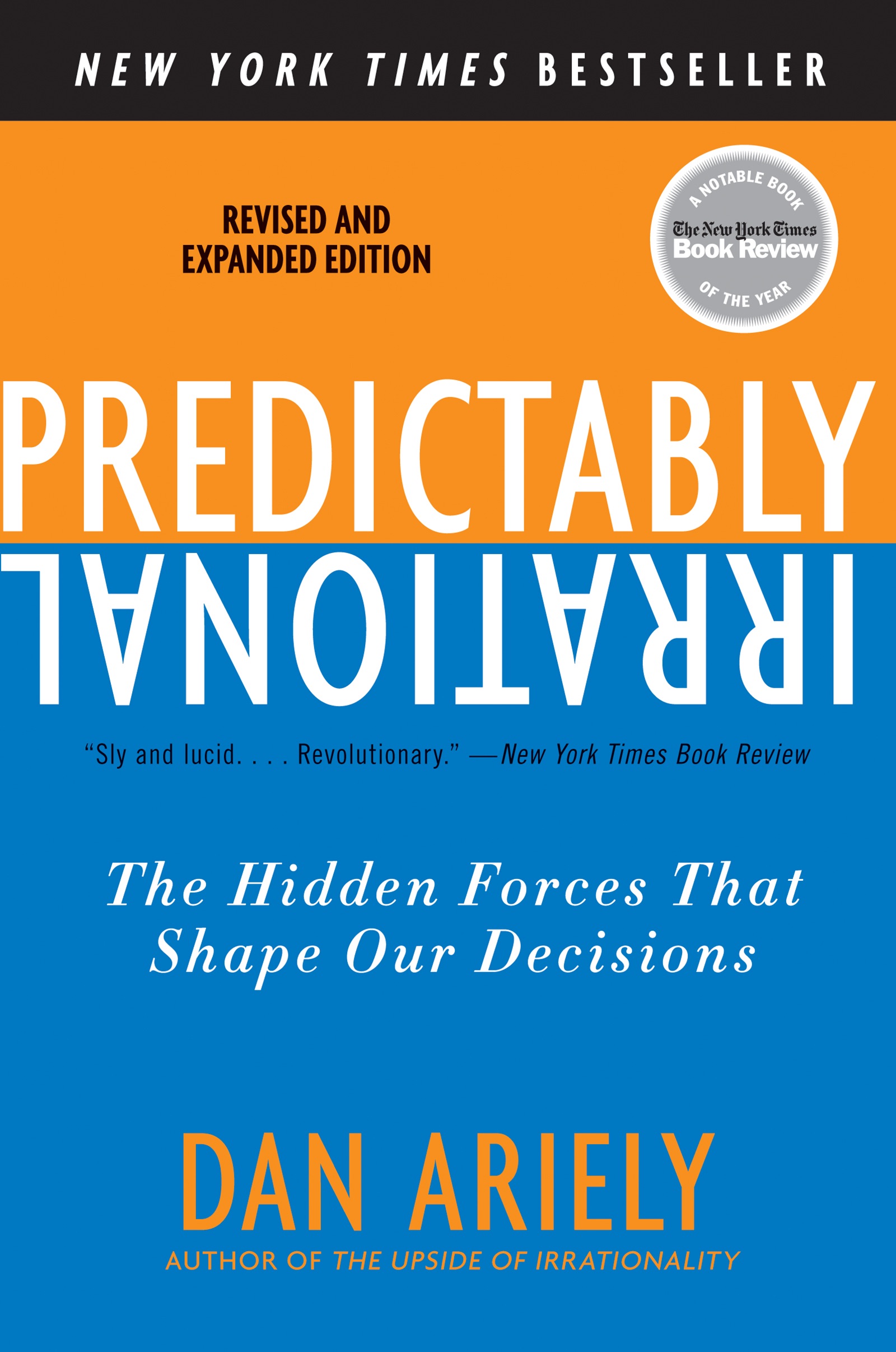
Predictably Irrational
Dan Ariely
My take
The idea I keep coming back to is how much a choice depends on what’s sitting beside it. My notes from this book return to relative value: menus, subscription options, the examples we use to decide what we want. A price can look reasonable because another price makes it look that way. A life can feel inadequate because we’ve chosen a particular person to compare it with. The comparison deserves as much attention as the decision.
I find this especially useful when thinking about marketing. Presenting an offer also means choosing the context in which someone evaluates it. That comes with a responsibility to make the value understandable. For my own decisions, the practical lesson is to write down what matters before the options start telling me what to want. I take the book as a set of prompts for examining choices, with room to test where each idea actually applies.
Core insight 1: Choose the comparison before it chooses for you
An option can seem attractive because it’s better than the one next to it. That tells us something about the comparison, but it leaves open whether either option suits the problem we’re trying to solve.
We don’t have an internal value meter that tells us how much things are worth. Rather, we focus on the relative advantage of one thing over another, and estimate value accordingly.
The useful pause comes before ranking. A subscription with extra features might offer more for the money while still costing more than the version I’d actually use. Defining the job first gives the comparison a purpose.
How to practice: Before opening a pricing page, write down the outcome you need, the features you’d use, and your spending limit. Compare each option with those requirements, including the option of buying nothing.
Core insight 2: Yesterday’s price can become today’s rule
The first price we accept can become a reference for later decisions. After that, a familiar number may feel appropriate mainly because we’ve paid it before. Repeating the choice can make the original reasoning harder to see.
In other words, the sensitivity we show to price changes might in fact be largely a result of our memory for the prices we have paid in the past and our desire for coherence with our past decisions—not at all a reflection of our true preferences or our level of demand.
I read this as a reason to revisit the starting point. A renewal deserves a fresh assessment of the value it provides now. The old price is useful information, but it shouldn’t make the decision on its own.
How to practice: Pick one recurring purchase. Estimate what its current benefit is worth to you before looking at the renewal price, then compare alternatives. Notice how much your estimate changes once the familiar number appears.
Core insight 3: Payment changes what people think the relationship is
A favor, a gift, and a paid assignment carry different expectations. Adding a small payment can change the meaning of a request: someone who’d gladly help a friend may evaluate the same task differently once it’s presented as a job.
MONEY, AS IT turns out, is very often the most expensive way to motivate people. Social norms are not only cheaper, but often more effective as well.
The distinction needs care. Friendship and purpose shouldn’t become excuses to underpay people. What I find useful is the reminder to make the relationship explicit, especially when a friendly request starts turning into recurring work.
How to practice: Before asking for help, decide whether you’re requesting a voluntary favor or commissioning work. Make the scope easy to understand and refusal easy to give. If it’s a job, agree on fair compensation before it starts.
Core insight 4: Expectations can arrive before the experience
The words around an experience can influence how we approach it. A warning, a confident introduction, or a dismissive comment may direct attention before we’ve had a chance to form our own view.
The moral, as you might expect, is that if you tell people up front that something might be distasteful, the odds are good that they will end up agreeing with you—not because their experience tells them so but because of their expectations.
This gives me a useful check for both giving and receiving feedback. When I explain what I think is wrong with a draft before someone reads it, I may be teaching them what to notice. Their response becomes harder to separate from my introduction.
How to practice: When you want an independent reaction to a draft or idea, share it with a neutral description of its purpose. Ask for observations before explaining your concerns, then compare the two sets of notes.
Core insight 5: Decide what enough looks like before moving the target
Relative value reaches beyond shopping. A better salary, a larger audience, or a more impressive title can become the new baseline as soon as someone nearby has more. Progress then changes the comparison without settling the desire.
That’s a lesson we can all learn: the more we have, the more we want. And the only cure is to break the cycle of relativity.
I want to distinguish a goal that serves my life from one that keeps changing with the people I happen to watch. A useful target should describe something I can recognize in my own days.
How to practice: For one goal, write a concrete definition of enough: the expense covered, the time available, or the work you want to be able to do. Revisit that definition before raising the target in response to someone else’s result.
Core insight 6: Treat your ideas as things you can revise
Ownership can make a view feel personal. When a proposal has my name on it, criticism can start to feel like a judgment of me. That attachment can make defending the idea more appealing than examining it.
Ownership is not limited to material things. It can also apply to points of view.
The distinction I want to preserve is between responsibility for a decision and permanent loyalty to it. I can explain why an idea made sense, recognize what new information changes, and revise it without pretending the earlier reasoning never existed.
How to practice: Before committing to a proposal, write down one observation that would make you reconsider it. In the review, evaluate that condition alongside the results, and give someone else room to argue for a different interpretation.
Predictably Irrational gives me reasons to inspect the context around a choice: the comparison, the familiar price, the expectation, and the attachment. I want to define what matters while I still have room to notice those influences. The point is to make a decision I can explain beyond how persuasive it felt at the time.
Enjoyed this? You'll like Open Loops.
Every Thursday, I share what I’m learning about growth, work, and the long game. Join 3K+ readers.
You might also like