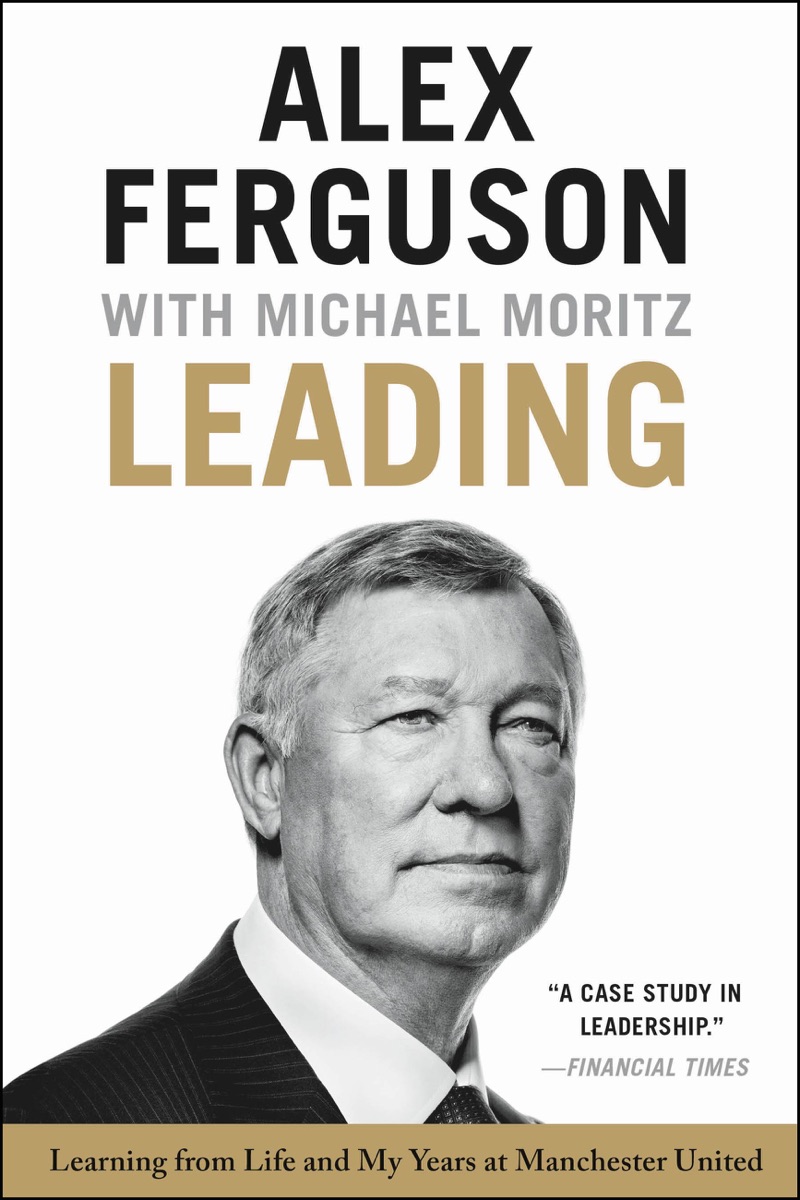
Leading
Alex Ferguson & Michael Moritz
My take
I didn’t expect a football memoir to read like a management book, and that’s exactly what makes this one land. Ferguson ran Manchester United for twenty-six years, and instead of a highlight reel he sat down with Michael Moritz, a venture capitalist, to pull the whole thing apart into how you actually build and lead something over a long stretch of time. What stayed with me wasn’t the trophies, it was how ordinary the levers are. He won by watching more than he talked, by protecting discipline when it would have been easier to bend it, by choosing players with drive over players with pure talent, and by understanding that no team worth having gets built in a single season. The parts I marked were the quiet ones: listen to your youngest people because they see the present more clearly than you do, care about the details without trying to touch all of them, and know whether you’re built to lead or to sit second, because pretending otherwise costs everyone. Having spent years around founders, I kept nodding, because the ones who last aren’t the loudest or the most gifted. They’re the ones who show up and keep building on the days nobody’s watching.
Core insight 1: Watching and listening beat talking
The most repeated idea in the whole book is almost embarrassingly simple. Ferguson credits most of what he learned not to talking but to watching people, listening to them, and reading about them. For a man famous for tearing into a locker room, the real skill was restraint: he studied the room before he filled it. It reframes attention itself as the leader’s first tool, the one that costs nothing and gets used least.
There’s a reason that God gave us two ears, two eyes and one mouth. It’s so you can listen and watch twice as much as you talk. Best of all, listening costs you nothing.
Watching others, listening to their advice and reading about people are three of the best things I ever did.
How to practice: Before your next meeting, decide how much you plan to say and cut it in half. Spend the first ten minutes watching who defers to whom and who goes quiet. The information you were about to talk over is usually the information you came for.
Core insight 2: Discipline is the floor under everything
Ferguson puts discipline above talent, above tactics, above almost everything. He admits it may have cost him titles, and says he’d do it again, because the moment you let discipline slide you aren’t being generous, you’re setting the stage for anarchy. What he’s describing isn’t punishment. It’s the consistency that lets a group trust the standard is real.
Once you bid farewell to discipline you say goodbye to success.
I always felt that our triumphs were an expression of the consistent application of discipline.
How to practice: Pick the one standard you keep bending because enforcing it feels petty. Hold it for a month with no exceptions and watch how fast people stop testing it. The standard was never the rule, it was whether you meant it.
Core insight 3: The gap between managing and leading is ownership
Ferguson is blunt that skilled managers can be hired by the truckload and leaders are the rarest of commodities. The difference he keeps circling is that a leader thinks like an owner even when he owns nothing, and his real job is to make people believe they can do what they thought they couldn’t. Management keeps the machine running. Leadership changes what the people inside it believe is possible.
The great leader possesses an unusual, and essential, characteristic, he will think and operate like an owner, or a person who owns a substantial stake of the business, even if, in a financial or legal sense, he is neither.
It was to chart a course that had not been pursued before. It was to make everyone understand that the impossible was possible. That’s the difference between leadership and management.
How to practice: Take one person on your team and name out loud a level you believe they can reach that they don’t yet see in themselves. Then hold them to it. Most people rise to the estimate of someone they respect who refuses to lower it.
Core insight 4: You learn more from losing than winning
Ferguson treats defeat as information, not shame. He says plainly that you learn more from defeats than from victories, and that losing can even be a useful tool as long as it never turns into a habit. The thing he actually watches is how someone reacts to a loss, because that reaction, not the win, is what tells you whether they’ll last.
The experience of defeat, or more particularly the manner in which a leader reacts to it, is an essential part of what makes a winner.
Losing is a powerful management tool so long as it does not become a habit.
How to practice: After your next setback, delay the post-mortem by a day and watch your own reaction first. Whether you reach for blame or for the lesson tells you more about your ceiling than the result ever will.
Core insight 5: Drive beats talent
Given the choice, Ferguson takes grit over gift every time. He’d pick the good player with relentless determination over the brilliant one who’s short on desire, because talent without drive burns bright and then stalls. And he noticed that drive spreads in a way skill never does: one hungry person can lift an entire room.
if I had to choose between someone who had great talent but was short on grit and desire, and another player who was good but had great determination and drive, I would always prefer the latter.
One player’s drive can have an enormous effect on a team, a winning drive is like a magical potion that can spread from one person to another.
How to practice: When you’re choosing between two people, weight how badly each one wants it over how naturally gifted they are. The gifted one impresses you in the interview. The driven one is still there when it gets hard.
Core insight 6: Respect over being loved or feared
Ferguson had a reputation for fear, but he’s explicit that fear was a tool used sparingly and never the goal. He didn’t need his players to love him, and he knew fear on its own gets you nothing that lasts. What he built for was respect, because respect is the only one of the three that keeps people following you when you’re not in the room.
As a leader, you don’t need to be loved, though it is useful, on occasion, to be feared. But, most of all, you need to be respected.
I never expected the players to love me, but neither did I want them to hate me, because that would have made it impossible to extract the most from them.
How to practice: Stop measuring whether your team likes you and start noticing whether they’d back your call with you out of the room. Being liked is pleasant and fragile. Respect is what holds under pressure.
Core insight 7: Care about the details, but let people own them
This is the one I marked hardest, because it’s the trap every driven person falls into. Ferguson cared enormously about small things, yet he learned that trying to check everything is the fastest way to drain the drive out of the people he hired to handle it. His answer was to tell people he cared about the details and that attending to them was their job, not his. He called himself the puppet master, not the control freak.
it is better to explain to the people around you that you care about little details, but that it’s their job to attend to them.
The great leader knows that most success comes from making a few large decisions correctly rather than trying to be involved in making lots of small choices.
How to practice: List everything you checked personally last week. Circle the few only you could have done, and hand the rest back to the people who own them. Caring about a detail and doing it yourself are not the same act.
Core insight 8: Nothing worth building happens in a hundred days
Ferguson had no patience for the fantasy of the quick turnaround. He points out that no winning organisation was ever built in its first hundred days, and that if you want one you have to keep building every single day. It’s a quiet rebuke to anyone waiting on one big move. The work is the accumulation, not the moment.
No winning organisation has ever been built in the first 100 days. If you want to build a winning organisation, you have to be prepared to carry on building every day.
When you run any organisation, you have to look as far down the road as you can.
How to practice: Judge your progress on a horizon long enough to be honest, in seasons, not weeks. The stretches that feel like nothing is happening are usually the ones doing the building.
Leading works because Ferguson isn’t selling a philosophy, he’s reporting what actually held up across twenty-six years of pressure. Strip away the football and what’s left is unglamorous and durable: watch more than you talk, protect the standard, pick drive over talent, and keep building on the days no one’s counting. Read this if you lead anyone, or want to, and you’re tired of leadership advice that has never survived contact with a real season.
Other reminders
You cannot lead by following.
Don’t play the occasion, play the game.
If you need one person to change your destiny, then you have not built a very solid organisation.
Leaders are usually unaware, or at least underestimate, the motivating power of their presence. Nobody sees themselves as others see them.
If I were running a company, I would always want to listen to the thoughts of its most talented youngsters, because they are the people most in touch with the realities of today and the prospects for tomorrow.
Part of the pursuit of excellence involves eliminating as many surprises as possible because life is full of the unexpected.
Perhaps the most important element of each activity is to inspire a group of people to perform at their very best.
Many people cannot stop long enough to listen, especially when they become successful and all the people around them are being obsequious and pretending to hang on their every word.
Enjoyed this? You'll like Open Loops.
Every week I share ideas on clarity, growth, and building a life that feels like yours. Join 3K+ readers.
You might also like