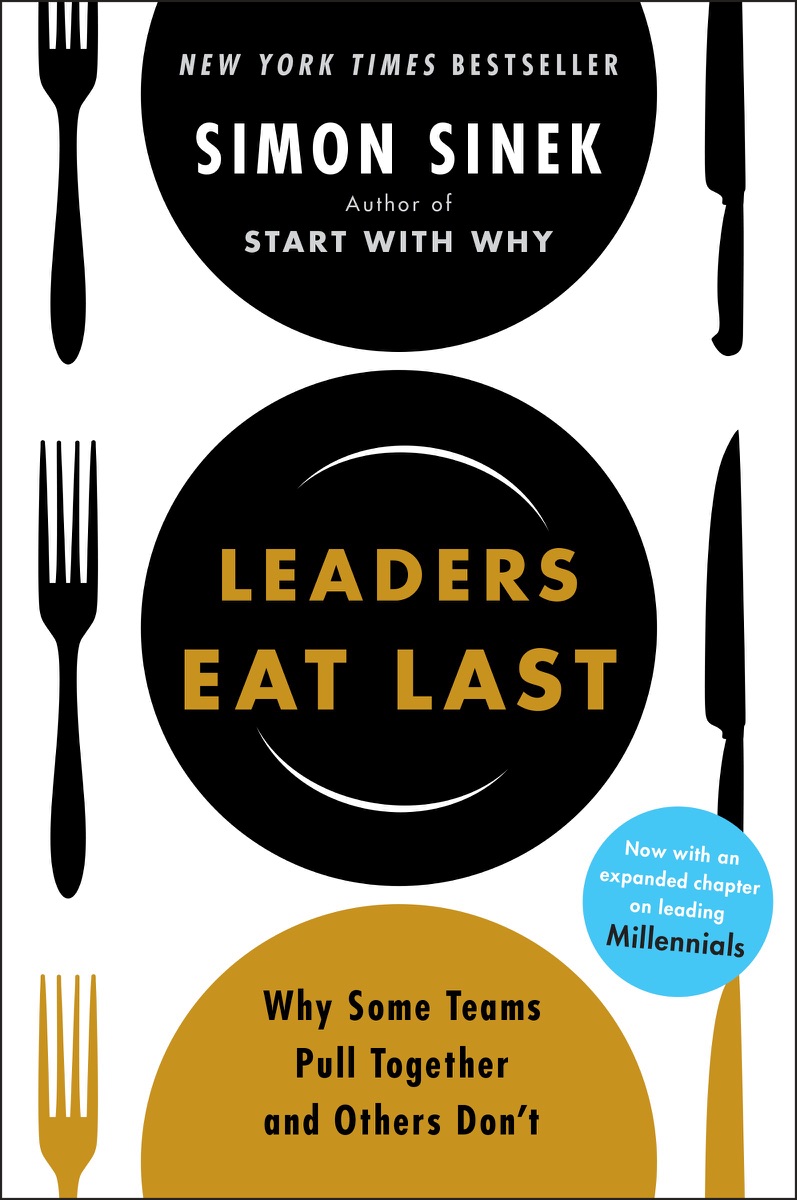
Leaders Eat Last
Simon Sinek
My take
I came to this book skeptical, because the title sounds like the kind of thing that gets quoted on a LinkedIn post and never thought about again. What changed my mind was that Sinek doesn’t argue leadership as a virtue. He argues it as biology. The reason a team pulls together or falls apart isn’t motivation or talent, it’s whether the people in it feel safe from each other. When leaders absorb the danger from outside, the group turns its energy outward and does remarkable things. When leaders protect themselves first, everyone else starts watching their own back, and the organization slowly eats itself. Having worked with a lot of founders, I’ve watched this play out more times than I can count: the teams that felt protected took bigger risks and recovered faster, and the ones that didn’t, spent their best energy managing internal politics. The phrase “leaders eat last” is literal, drawn from the Marines, where the most senior are served last and no order is given. But the idea underneath it is the part worth keeping. Leadership is not a reward you collect for climbing. It’s a responsibility you take on for the people now standing behind you.
Core insight 1: Leadership is a choice, not a rank
The most freeing idea in the book is that leadership has almost nothing to do with your title. You can hold a senior position and lead no one. You can have no formal authority and lead everyone around you. What separates the two isn’t the org chart, it’s the willingness to put the people in your care ahead of your own comfort. This matters because it removes every excuse. You don’t need permission or a promotion to start leading. You need the decision.
The rank of office is not what makes someone a leader. Leadership is the choice to serve others with or without any formal rank.
Leadership is not a license to do less; it is a responsibility to do more.
How to practice: Stop waiting for the role before you act like a leader. Find one person around you who needs cover, an opinion defended, credit redirected, a mistake absorbed, and give it to them this week. Notice that nothing about your title changed and you led anyway.
Core insight 2: Build a Circle of Safety
Sinek’s central image is the Circle of Safety: the boundary a leader draws around a team so its members don’t have to defend themselves from one another. Outside the circle are real dangers, the market, competitors, uncertainty. Inside, people should feel protected. The leader’s job is to keep that line strong, because the moment people sense danger from inside, they stop facing the danger outside. All that survival energy turns inward, and the organization gets weaker exactly when it needs to be strong.
When the people have to manage dangers from inside the organization, the organization itself becomes less able to face the dangers from outside.
Trust is like lubrication. It reduces friction and creates conditions much more conducive to performance.
How to practice: Watch where your team spends its anxiety. If people are guarding against each other, covering themselves in emails, hedging in meetings, the circle has a hole in it. Your work isn’t to push them harder, it’s to make the inside safe enough that they can aim outward again.
Core insight 3: Stress comes from control, not workload
This was the reframe I didn’t expect from a leadership book. We assume burnout comes from too much work. The research Sinek cites says otherwise: the strongest predictor of stress isn’t how hard the job is, it’s how little control people feel over how they do it. Hard work with autonomy energizes people. Light work under constant surveillance corrodes them. Most managers try to reduce stress by reducing demands, when the lever that actually matters is giving people more say over their own day.
It is not the demands of the job that cause the most stress, but the degree of control workers feel they have throughout their day.
No one wakes up in the morning to go to work with the hope that someone will manage us. We wake up in the morning and go to work with the hope that someone will lead us.
How to practice: Before you lighten someone’s load, try widening their authority. Hand them the decision, not just the task. Ask where they feel micromanaged, then remove yourself from that loop and watch what happens to their energy.
Core insight 4: The real cost of leadership is self-interest
The title comes alive here. Leaders go first into danger and last to the food. The perks, the corner office, the bigger paycheck, those aren’t the prize for leading, they’re the down payment on a debt. We grant leaders advantages because we expect them to spend those advantages protecting us. The leader who takes the perks but skips the protection has broken the deal, and people feel it instantly, even when they can’t name it.
Leaders are the ones who are willing to give up something of their own for us. Their time, their energy, their money, maybe even the food off their plate. When it matters, leaders choose to eat last.
The leaders of great organizations do not see people as a commodity to be managed to help grow the money. They see the money as the commodity to be managed to help grow their people.
How to practice: The next time leadership costs you something, a comfortable answer, credit you wanted, a risk you’d rather someone else carried, treat that cost as the actual job. Eating last is not a metaphor you admire. It’s a small daily transaction you either make or don’t.
Core insight 5: Trust is built across a table, not a screen
Sinek is blunt about the limits of doing everything remotely. Trust, the kind that makes people cover for each other under pressure, forms through presence: shared meals, time spent not working, the small human exchanges that no message thread reproduces. This isn’t nostalgia. It’s a caution that as more of our work moves behind screens, we shouldn’t expect the depth of trust that only forms face to face to show up on its own.
Trust is not formed through a screen, it is formed across a table. It takes a handshake to bind humans, and no technology yet can replace that. There is no such thing as virtual trust.
How to practice: Audit how your most important relationships are maintained. If the answer is “entirely through messages,” you’re probably running on a trust balance you built earlier and haven’t topped up. Find a table. Share a meal with no agenda. That’s not a break from the work, it’s the foundation under it.
Core insight 6: Be the leader you wish you had
Sinek ends where it counts: you don’t actually need permission, and you don’t need to wait for better people above you. If the leaders over you won’t extend protection, you can extend it sideways, to your peers, your reports, the person next to you. The culture you wish existed starts the moment someone stops waiting for it and begins acting it out. Usually that someone has no special authority. They just decided to go first.
We are not victims of our situation. We are the architects of it.
As employees or members of the group, we need the courage to take care of each other when our leaders don’t. And in doing so, we become the leaders we wish we had.
How to practice: Stop auditing the leaders above you and start being the one below you needed. Protect someone who can’t protect themselves yet. The fastest way to fix a culture you can’t control is to model the one you want, today, at your own level.
Leaders Eat Last is really one idea explored from many angles: leadership is the willingness to trade your own safety for someone else’s. The biology gives it teeth, but the practice is simpler than the science. It shows up in who you protect when it’s inconvenient, and who eats first when there isn’t enough to go around. Read this if you’ve ever confused being in charge with being a leader, and want to feel the difference.
Other reminders
You can easily judge the character of a man by how he treats those who can do nothing for him.
If your actions inspire others to dream more, learn more, do more and become more, you are a leader.
It is not the genius at the top giving directions that makes people great. It is great people that make the guy at the top look like a genius.
My favorite definition of love is giving someone the power to destroy us and trusting they won’t use it.
For most of us, we have warmer feelings for the projects where everything seemed to go wrong, where the group stayed late, ate cold pizza, and barely made the deadline. Those are the ones we remember.
Leadership is about integrity, honesty and accountability. All components of trust.
The goal of a leader is to give no orders. Leaders are to provide direction and intent and allow others to figure out what to do and how to get there.
Enjoyed this? You'll like Open Loops.
Every week I share ideas on clarity, growth, and building a life that feels like yours. Join 3K+ readers.
You might also like