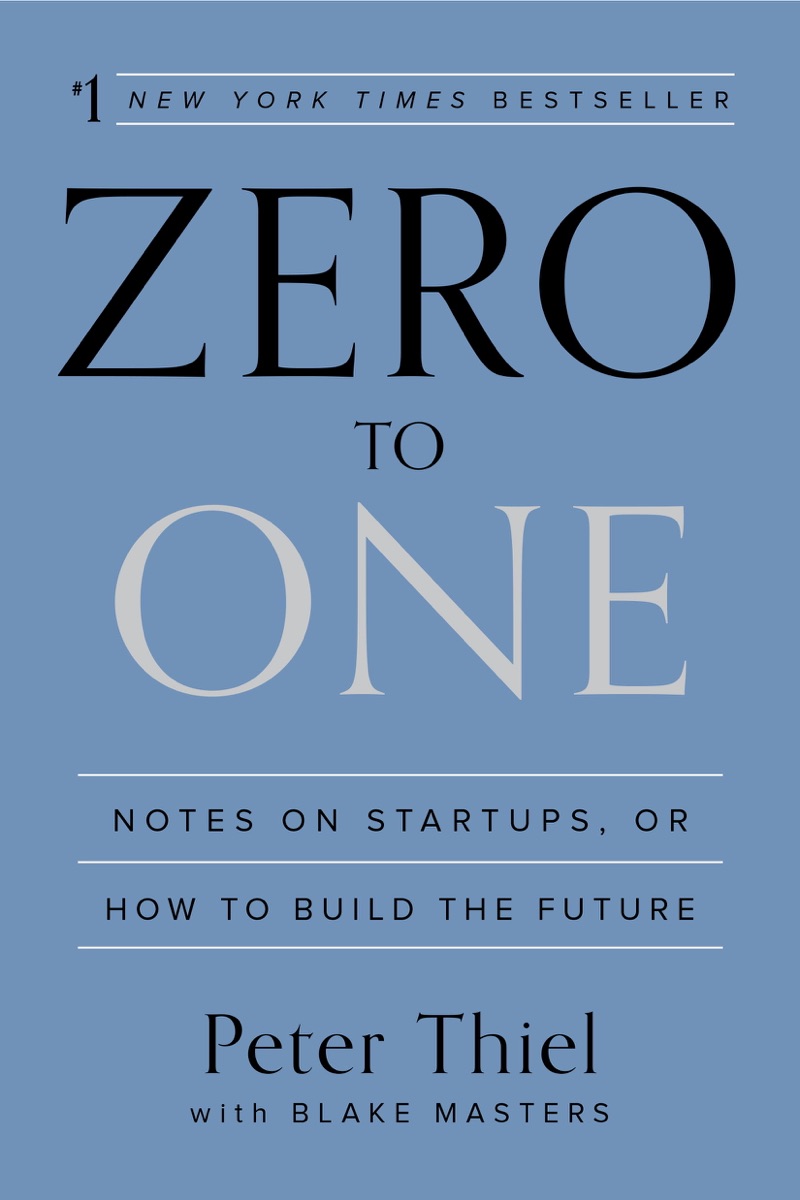
Zero to One
Peter Thiel
My take
This is the book I wish someone had handed me before my first startup. Not because it gives you a playbook, but because it reframes the entire game. Most business advice is about doing what works slightly better than the next person. Thiel’s argument is that the real value is in doing something nobody else is doing at all. Going from zero to one, not one to n. After 12 years of working with founders, the pattern holds: the companies that break out aren’t the ones that competed harder. They’re the ones that found a problem nobody else was even looking at and built something so different that competition became irrelevant. Zero to One doesn’t tell you how to build a startup. It tells you how to think about whether the thing you’re building is worth building in the first place.
Core insight 1: Creation beats competition
The default mode in business is imitation: find what works and do it slightly better. Thiel flips this. Real value comes from creating something entirely new, from going from zero to one. Copying, even improving, is going from one to n. The distinction matters because it determines whether you’re playing a game with compounding returns or one where every advantage gets competed away.
Every moment in business happens only once. The next Bill Gates will not build an operating system. The next Larry Page or Sergey Brin won’t make a search engine. If you are copying these guys, you aren’t learning from them.
The most dangerous trap for smart people is finding a proven model and thinking they can execute it better. The leverage is in finding what hasn’t been built yet.
How to practice: Before building anything, ask: am I going from zero to one, or from one to n? If the answer is n, the ceiling is lower than you think.
Core insight 2: Competition is the opposite of capitalism
We’ve been taught that competition is healthy, that it sharpens products and drives innovation. Thiel argues the opposite: competition destroys profits. Under perfect competition, nobody makes money. The goal of any business is to escape competition entirely, not to win it.
Americans mythologize competition and credit it with saving us from socialist bread lines. Actually, capitalism and competition are opposites. Capitalism is premised on the accumulation of capital, but under perfect competition all profits get competed away.
All failed companies are the same: they failed to escape competition.
This reframes the entire strategic question. Instead of asking “how do we beat competitors?”, the better question is “how do we build something where there are no competitors?”
How to practice: Audit your competitive landscape honestly. If you’re in a dogfight, you’re in the wrong market. The real move is to redefine the market until you’re the only one in it.
Core insight 3: Every great business is built around a secret
Thiel defines a “secret” as something important and true that most people don’t agree with or haven’t noticed. Great companies are built on secrets: insights about the world that others have missed. The company itself becomes a conspiracy to act on that secret before the rest of the world catches on.
The best entrepreneurs know this: every great business is built around a secret that’s hidden from the outside. A great company is a conspiracy to change the world; when you share your secret, the recipient becomes a fellow conspirator.
The implication is uncomfortable: if your business idea is obvious and widely agreed upon, it’s probably not a great business. The best opportunities live in territory most people have dismissed as impossible or uninteresting.
How to practice: Ask Thiel’s contrarian question seriously: what important truth do very few people agree with you on? Your answer might be the foundation of something worth building.
Core insight 4: Start small and monopolize
The path to a great company doesn’t start with a massive market. It starts with a small, specific niche you can dominate completely. Once you own that niche, you expand into adjacent markets. Trying to capture a tiny slice of a huge market is the surest way to build something forgettable.
The most successful companies make the core progression, to first dominate a specific niche and then scale to adjacent markets, a part of their founding narrative.
Facebook started with Harvard students. Amazon started with books. The initial market was so small it barely looked like a business. That’s the point.
How to practice: If your market description includes the word “billion,” you’re thinking about it wrong. Find the smallest viable market you can own outright, then expand from a position of dominance.
Core insight 5: Definite optimism is the only posture that builds
Thiel maps four worldviews: definite optimism, indefinite optimism, definite pessimism, and indefinite pessimism. The only one that creates the future is definite optimism: a clear vision of a better future paired with a concrete plan to build it. Indefinite optimism, believing things will get better without knowing how, produces process without substance. Portfolio thinking. Optionality hoarding.
Instead of pursuing many-sided mediocrity and calling it “well-roundedness,” a definite person determines the one best thing to do and then does it.
By the time a student gets to college, he’s spent a decade curating a bewilderingly diverse resume to prepare for a completely unknowable future. Come what may, he’s ready for nothing in particular.
The critique cuts deep because it describes how most ambitious people actually operate: collecting options instead of committing to a vision.
How to practice: Stop optimizing for optionality. Pick the future you believe in and build toward it with a specific plan. Indefinite optimism is just hope without a blueprint.
Core insight 6: Distribution matters as much as product
Engineers tend to believe that great products sell themselves. Thiel calls this out as one of the most dangerous delusions in tech. Distribution, how you get the product to customers, is just as important as the product itself. If you haven’t figured out distribution, you don’t have a business.
If you’ve invented something new but you haven’t invented an effective way to sell it, you have a bad business, no matter how good the product.
The deeper point is that most technical founders underinvest in distribution because they find it intellectually less interesting. But the companies that win are usually the ones that figured out a distribution channel their competitors couldn’t replicate.
How to practice: For every product decision, spend equal time on the distribution question. The best product with no distribution path loses to a good product with a great one.
Core insight 7: Lean iteration has limits
The post-2000 startup orthodoxy is to build minimum viable products, iterate based on feedback, and avoid grand plans. Thiel argues this is overcorrection. Iteration without a bold thesis leads to local maxima. You end up building the best version of something small instead of the first version of something new.
Making small changes to things that already exist might lead you to a local maximum, but it won’t help you find the global maximum.
Darwinism may be a fine theory in other contexts, but in startups, intelligent design works best.
This isn’t a rejection of customer feedback. It’s a rejection of the idea that you can increment your way to a breakthrough. Breakthroughs require conviction, not just data.
How to practice: Use lean methods for execution, not for vision. Your thesis about the future should come from deep thinking and conviction, not from A/B tests.
Core insight 8: Successful people find value in unexpected places
The common thread among the best founders and investors Thiel has worked with is simple: they think from first principles, not from formulas. They ask what’s true, not what’s trendy. This is harder than it sounds because social proof is the dominant force in how most people make decisions.
The single most powerful pattern I have noticed is that successful people find value in unexpected places, and they do this by thinking about business from first principles instead of formulas.
Brilliant thinking is rare, but courage is in even shorter supply than genius.
The bottleneck isn’t intelligence. It’s the willingness to believe something unpopular and act on it before anyone validates your view.
How to practice: When you catch yourself following a formula or copying a model, pause. The formula works until everyone uses it. First-principles thinking is slower, lonelier, and where the real edges live.
Zero to One isn’t a startup manual. It’s a thinking framework for anyone who wants to build something that matters instead of something that merely exists. The core provocation is simple: the future won’t be built by people who copy what works. It’ll be built by people willing to believe something nobody else believes, and then build the proof. That takes more than intelligence. It takes the kind of courage most people spend their careers avoiding.
Other reminders
What important truth do very few people agree with you on?
Competition can make people hallucinate opportunities where none exist.
The best projects are likely to be overlooked, not trumpeted by a crowd; the best problems to work on are often the ones nobody else even tries to solve.
A startup is the largest endeavor over which you can have definite mastery. You can have agency not just over your own life, but over a small and important part of the world. It begins by rejecting the unjust tyranny of Chance. You are not a lottery ticket.
Finance epitomizes indefinite thinking because it’s the only way to make money when you have no idea how to create wealth.
No company has a culture; every company is a culture.
Moving first is a tactic, not a goal.
Once you’re 10x better, you escape competition.
If you’re less sensitive to social cues, you’re less likely to do the same things as everyone else around you.
The road doesn’t have to be infinite after all. Take the hidden paths.
Enjoyed this? You'll like Open Loops.
Every week I share ideas on clarity, growth, and building a life that feels like yours. Join 3K+ readers.
You might also like