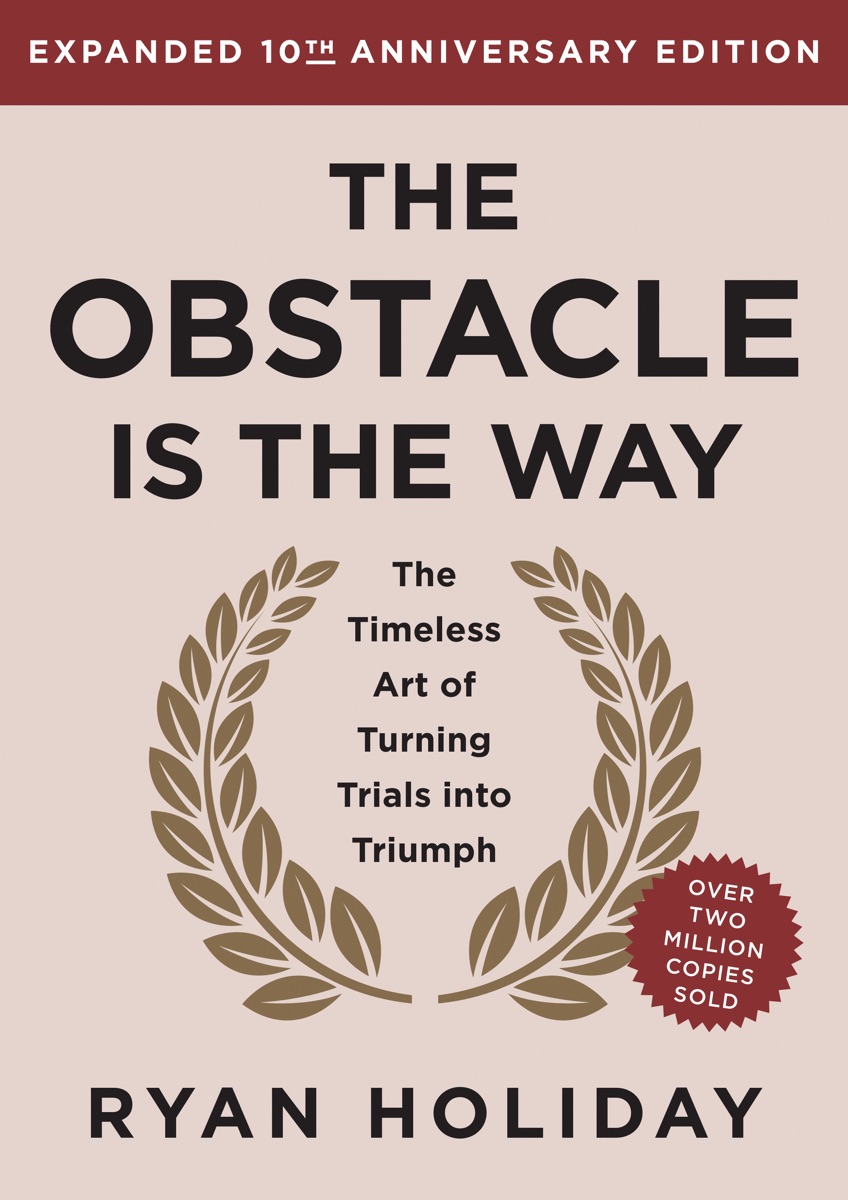
The Obstacle Is the Way
Ryan Holiday
My take
It’s easy to turn Stoicism into a personality where nothing gets to you and every setback becomes a chance to prove how tough you are. This book gave me a more useful version. The point isn’t to pretend the hard thing isn’t hard. It’s to notice that the event and the meaning you give it arrive separately. The delay, the rejection, the thing that didn’t work, it all becomes much heavier when you immediately turn it into a verdict about yourself or the future. Holiday keeps bringing you back to the small amount that remains yours: your judgment, your next move, and the story you decide to keep repeating. That doesn’t make obstacles pleasant. It makes them less final.
Core insight 1: The story is usually the first obstacle
Most of the time, the thing that knocks us off course isn’t the event itself. It’s the meaning that shows up right after it. A missed opportunity becomes proof that we’re behind. A hard conversation becomes proof that the relationship is broken. By the time we start reacting, we’re often reacting to a story we wrote in seconds, not to the thing that actually happened.
There is the event itself and the story we tell ourselves about what it means.
How to practice: When something goes wrong, separate the facts from the interpretation before you decide what the moment says about you.
Core insight 2: Composure keeps the exits visible
Pressure narrows your field of view. You stop seeing options because your nervous system has already decided there are none. This book is a reminder that composure isn’t passivity. It’s what lets you see the countermove that panic would have hidden from you.
There is always a countermove, always an escape or a way through.
How to practice: Before making the problem bigger in your head, ask what one available move still exists, even if it’s small.
Core insight 3: Your power lives in the response, not the circumstance
There is a clean line running through the book: external events are not yours to command, but your choices around them are. That can sound obvious until you’re in the middle of something you didn’t choose. Then it’s easy to spend all your energy arguing with reality. The book keeps moving that energy back to the only place it can do anything.
Where will I find good and bad? In me, in my choices.
How to practice: Notice where you’re trying to control the situation itself. Then put that energy into the part that is still yours.
Core insight 4: An impression is not a verdict
The first feeling is often loudest, which is why it gets mistaken for the truth. A criticism lands and suddenly you’re convinced it defines you. A setback arrives and suddenly the future looks decided. Holiday’s Stoic move is simple but hard: pause long enough to inspect the thought before you let it become your identity.
Hold on a moment; let me see who you are and what you represent.
How to practice: Give the first thought a few minutes before you build a plan around it. It may be information, but it isn’t automatically the conclusion.
Core insight 5: Friction can become direction
The strongest idea in the book is not that every obstacle is secretly good. It’s that resistance can tell you where the real work is. What blocks you can force a better question, a different skill, or a route you never would have considered from the easy path. The obstacle doesn’t need to disappear for it to become useful.
What stands in the way becomes the way.
How to practice: Instead of asking how to get around the friction as quickly as possible, ask what it is making visible.
This is the kind of book that works best as a reset, not a philosophy to perform. It doesn’t promise that every difficult thing will work out. It asks for something more grounded: see the situation clearly, act where you can, and stop handing the obstacle the authority to define the whole path.
Other reminders
The obstacle in the path becomes the path.
Where the head goes, the body follows.
Objective judgment, now at this very moment.
Our perceptions determine, to an incredibly large degree, what we are and are not capable of.
Every obstacle is unique to each of us. But the responses they elicit are the same.
Enjoyed this? You'll like Open Loops.
Every Thursday, I share what I’m learning about growth, work, and the long game. Join 3K+ readers.
You might also like