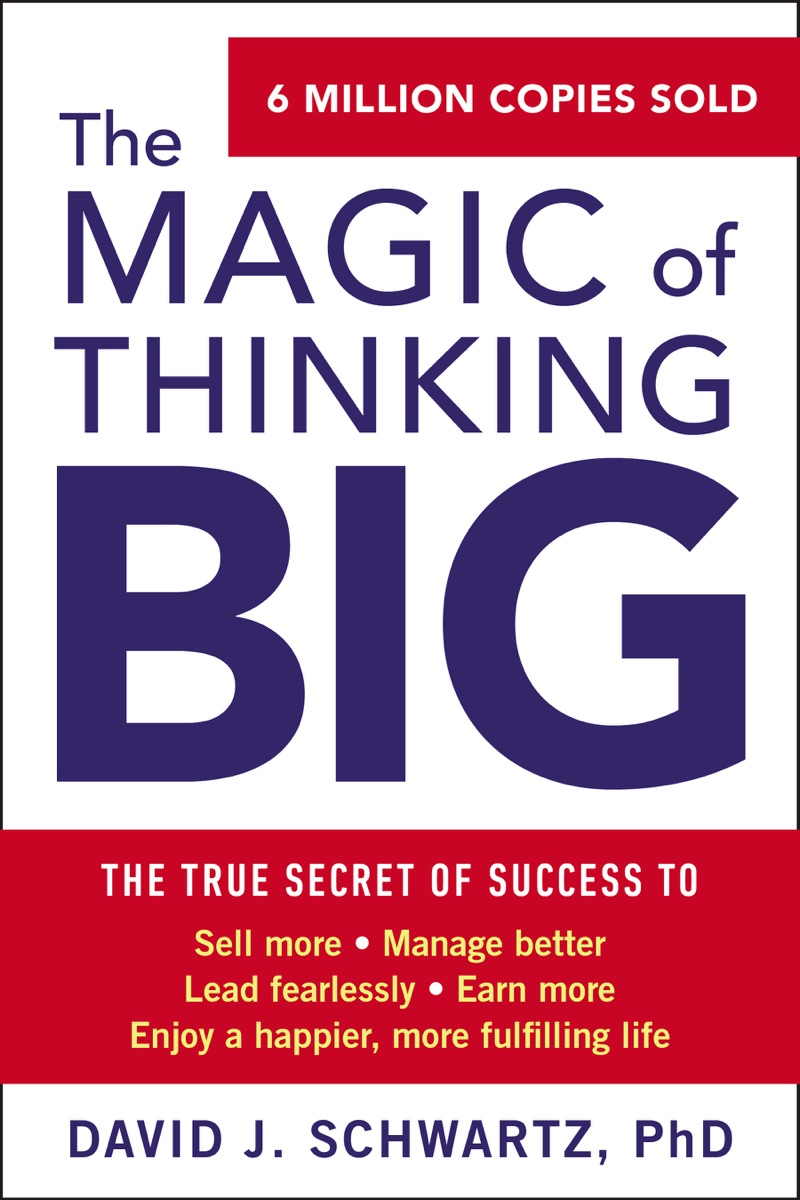
The Magic of Thinking Big
David J. Schwartz
My take
This book reads like something your ambitious uncle would hand you at a family barbecue, and that might be why I almost didn’t finish it. The language is dated, the examples feel mid-century, and the title sounds like a motivational poster. But the core mechanism Schwartz describes is one I keep coming back to years later: your mind has a thermostat, and that thermostat is set by the size of your thinking, not by your talent or circumstances. What he calls “thinking big” is not about delusion or empty optimism. It’s about the quiet ceiling you’ve placed on yourself without noticing, the one that tells you what’s “realistic” before you’ve actually tried. The most useful reframe in the book is that belief is not the reward you get after evidence arrives. Belief is the tool that generates the evidence. When you believe something can be done, your mind starts working on how. When you believe it can’t, your mind starts building the case for why. Same brain, different assignment. Everything else in the book flows from that one shift.
Core insight 1: Your mind works on assignment
Schwartz’s central insight is not “think positive.” It’s that your mind is always solving for something, and what it solves for depends on what you believe is possible. Tell yourself a goal is out of reach and your brain will dutifully surface every reason it can’t be done. Tell yourself it’s possible and the same brain starts surfacing paths forward. The quality of the assignment determines the quality of the output.
Believe it can be done. When you believe something can be done, really believe, your mind will find the ways to do it. Believing a solution paves the way to solution.
Those who believe they can move mountains, do. Those who believe they can’t, cannot.
How to practice: Pick one goal you’ve been treating as “nice but unrealistic.” For one week, operate as if it’s certain. Not delusional, just certain. Watch what your mind starts producing when the assignment changes from “why this won’t work” to “how this could work.”
Core insight 2: Action is the only cure for fear
This is the line from the book that stuck the longest: three words that compress years of therapy into a single principle. Fear does not dissolve through analysis, through waiting until you feel ready, or through collecting more information. It dissolves through motion. The people who act despite fear don’t have less of it. They just refuse to let it be the deciding vote.
Action cures fear.
People who get things done in this world don’t wait for the spirit to move them; they move the spirit.
The second quote reframes the entire relationship between motivation and action. Most people wait for inspiration before they start. The ones who build things worth looking at start first and let the inspiration catch up.
How to practice: When you notice yourself researching, planning, or deliberating past the point of usefulness, stop and take one concrete step. Send the email. Make the call. Write the first paragraph. The clarity you’re waiting for lives on the other side of the action, not before it.
Core insight 3: What you feed your mind is what your mind becomes
Schwartz introduces what he calls the “memory bank,” and the metaphor is sharper than it sounds. Every thought you deposit shapes the balance. Deposit fear, self-doubt, and replays of what went wrong, and your withdrawals will match. Deposit gratitude, competence, and evidence of what you’ve done well, and those start compounding too.
The mind is what the mind is fed.
The Notion note Reza left on this one was about the before-sleep ritual: just before you drift off, recall the good things. Count victories instead of failures. This is not denial. It’s choosing which data to run your next day’s operating system on.
How to practice: Before sleep, recall three things that went well today, no matter how small. Not affirmations. Actual evidence. You’re not lying to yourself. You’re choosing which version of the day to carry into tomorrow.
Core insight 4: See what can be, not what is
Big thinking is not about ignoring reality. It’s about refusing to let the current state of things define the permanent state of things. Schwartz calls this “adding value through visualization,” which sounds like corporate speak until you realize what he actually means: every situation has a version that’s better than the one you’re looking at, and your job is to see that version clearly enough to move toward it.
Look at things not as they are, but as they can be. Visualization adds value to everything. A big thinker always visualizes what can be done in the future. He isn’t stuck with the present.
Stretch your vision. See what can be, not just what is.
How to practice: Take one area of your life where you’ve accepted “this is just how it is.” Spend five minutes writing what it would look like if it were working at its best. Not fantasy. Concrete, specific, achievable best. The gap between where you are and what you just described is your actual work.
Core insight 5: The size of the thought determines the size of the result
There’s a story in the book about three bricklayers. Asked what they’re doing, the first says “laying bricks,” the second says “making $9.30 an hour,” and the third says “building the greatest cathedral.” Same job, three completely different relationships to the work. Schwartz’s argument is that the third bricklayer will always outperform the other two, not because he’s more talented, but because his framing gives the work meaning, and meaning generates energy.
A person who thinks his job is important receives mental signals on how to do his job better. And a better job means more promotions, more money, more prestige, more happiness.
Energy increases, multiplies, when you set a desired goal and resolve to work toward that goal.
How to practice: Rewrite the description of what you do, not in terms of tasks but in terms of impact. “I write code” becomes “I build tools that save people time.” “I manage a team” becomes “I create the conditions where good people do their best work.” The framing changes the effort you bring.
Core insight 6: Stay focused on the big objective
Schwartz observed that most people lose their energy not on big challenges but on small fights. They spend their sharpest thinking on trivial conflicts, office politics, and arguments that don’t move anything forward. The person who keeps their attention locked on what actually matters has a compounding advantage over the person who gets pulled into every minor skirmish.
You win when you refuse to fight petty people. Fighting little people reduces you to their size.
In sales, the big objective is winning sales, not arguments. In marriage, the big objective is peace, happiness and tranquility, not winning quarrels.
How to practice: Before reacting to something that bothers you, ask: “Is this really important?” If the honest answer is no, redirect the energy to something that is. The discipline is not in the fighting. It’s in the choosing.
Core insight 7: How you see people is how they perform
One of the quieter ideas in the book, but maybe the most practical: the way you treat people creates a feedback loop. Treat someone like they’re capable and they tend to rise. Treat them like they’re not and they tend to confirm it. Schwartz calls this being a “human engineer,” and the skill is simple: make people feel important, because they are.
Treating someone as second-class never gets you first-class results.
This particular thing about Phil: Phil was 100 percent positive. Phil could inspire others when they felt low. Phil understood people, and because he could really see what made them tick, he liked them.
How to practice: In your next conversation, focus entirely on making the other person feel valued. Not through flattery. Through genuine attention. Ask a real question. Listen to the full answer. Notice the shift in how they respond to you.
The Magic of Thinking Big is not a sophisticated book. It doesn’t need to be. The mechanism it describes is almost embarrassingly simple: the ceiling on your life is the ceiling on your thinking, and you’re the one who installed it. Raise the ceiling and the room gets bigger. The hard part is not understanding this. It’s remembering it on the days when everything around you is whispering “be realistic.”
Other reminders
The thinking that guides your intelligence is much more important than how much intelligence you have.
Build castles, don’t dig graves.
Then it dawned on me that no one else was going to believe in me until I believed in myself.
Hope is a start. But hope needs action to win victories.
A man big enough to be humble appears more confident than the insecure man who feels compelled to call attention to his accomplishments.
Nothing stands as a bigger challenge than making the most of yourself.
The main job of the leader is thinking. And the best preparation for leadership is thinking.
Meet problems and obstacles as they arise. The test of a successful person is not the ability to eliminate all problems before he takes action, but rather the ability to find solutions to difficulties when he encounters them.
Enjoyed this? You'll like Open Loops.
Every Thursday, I share what I’m learning about growth, work, and the long game. Join 3K+ readers.
You might also like