
My take
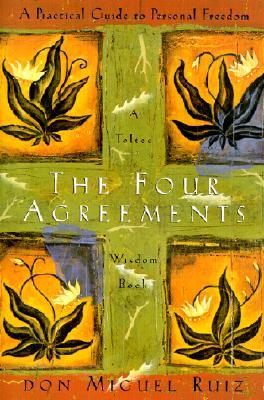
This book hides a lot behind its New Age presentation. Strip that away and what remains is one of the cleanest maps I’ve read of how we get in our own way. Ruiz frames the four agreements as ancient Toltec wisdom, but the mechanics are dead simple: you made quiet deals with yourself about who you are and how to behave, most of them before you were old enough to know you were making them, and now those deals run your life. The one that landed hardest for me was the claim that nobody in your life has ever abused you more than you have abused yourself. I resisted that line for weeks. Then I watched how true it was. The critic in my head had a vocabulary I would never tolerate from another person, and yet I let it narrate every day. What the book gave me was not a set of techniques but a different relationship with my own word: the thing you speak to yourself is the thing that shapes what you become. The rest of the book flows from that one reframe.
Core insight 1: Your word is most dangerous when you turn it on yourself
Ruiz doesn’t mean “don’t lie” when he says be impeccable with your word. He means stop using your own voice against yourself. Most of us have a clean enough policy about not tearing other people down. The policy we apply to ourselves is much crueler. Self-talk is not a background track. It’s the most consequential speech you make all day, because you’re both speaker and audience.
Being impeccable with your word is not using the word against yourself.
You can measure the impeccability of your word by your level of self-love. How much you love yourself and how you feel about yourself are directly proportionate to the quality and integrity of your word.
How to practice: Catch your next internal insult before it completes. Not to replace it with a positive affirmation, but to notice that you would not say this sentence to someone you love. Then decide whether to keep speaking to yourself that way.
Core insight 2: Nothing anyone does is about you
This is the one I come back to most. Every time I’ve been hurt by something someone said or did, the hurt has been downstream of an assumption I made: that what they did was a signal about me. It almost never is. People are in their own story, running their own programming, responding to their own unhealed wounds. You were a convenient surface.
Nothing other people do is because of you. It is because of themselves. All people live in their own dream, in their own mind; they are in a completely different world from the one we live in.
Personal importance, or taking things personally, is the maximum expression of selfishness because we make the assumption that everything is about me.
That second line is the one that burns. Taking things personally is not humility. It’s a kind of self-importance, the quiet belief that you were central enough to the other person’s world for their action to have been about you.
How to practice: The next time someone’s behavior stings, pause and finish this sentence before reacting: this is happening because of something in their world, not mine. It will usually be true, and it will almost always change your response.
Core insight 3: Assumptions are the quiet path to suffering
We fill in the blanks because the mind hates uncertainty. Someone doesn’t reply, so we decide they’re angry. A partner is quiet, so we decide they’re pulling away. Almost every argument I’ve ever had started with a story I built in my head and then treated as fact.
It is always better to ask questions than to make an assumption, because assumptions set us up for suffering.
We have the need to justify everything, to explain and understand everything, in order to feel safe. It is not important if the answer is correct; just the answer itself makes us feel safe.
The second quote is the deeper cut. We don’t assume because we want truth. We assume because we want relief from not knowing.
How to practice: When you catch yourself building a story about what someone meant, ask the question instead. Every time. It feels awkward at first. Then it starts feeling like freedom.
Core insight 4: Your best shifts, and that is not a problem
Most self-help books tell you to give 100 percent every day. Ruiz’s version is gentler and more useful. Your best when you’re sick is different from your best when you’re rested. Your best when you’re heartbroken is not your best when you’re happy. If you always do your actual best, no more and no less, there’s no basis for self-judgment.
Regardless of the quality, keep doing your best, no more and no less than your best. If you try too hard to do more than your best, you will spend more energy than is needed and in the end your best will not be enough.
Doing your best is taking the action because you love it, not because you’re expecting a reward.
How to practice: Judge your day by whether you showed up to whatever you were doing, not by whether you cleared an ideal output. The standard shifts with the state you’re in. Honesty about that state is the work.
Core insight 5: The warrior refrains, the victim represses
This one rewired how I think about emotional control. Repression is pretending a feeling isn’t there. Refraining is feeling it fully and choosing when to express it. The difference is not subtle. One is avoidance dressed up as discipline. The other is discipline with your eyes open.
The big difference between a warrior and a victim is that the victim represses, and the warrior refrains. Victims repress because they are afraid to show the emotions, afraid to say what they want to say. To refrain is not the same thing as repression. To refrain is to hold the emotions and to express them in the right moment, not before, not later.
Most people who think they have emotional discipline are actually repressing. You can feel the difference in your body. Repression is tight and eventually leaks. Refraining is open and waits.
How to practice: When a strong emotion comes up, ask whether you’re feeling it or stuffing it. If stuffing, feel it now. If feeling, ask what the right moment for expression looks like, and hold until then.
Core insight 6: The domestication is the thing to undo
Ruiz’s central claim about freedom is that most people are fully domesticated. The rules you live by were given to you by parents, teachers, religion, and culture, and most of them you never chose. The work of being free is not adding new beliefs. It is noticing which ones you inherited and deciding, one by one, whether they are still yours.
The real you is still a little child who never grew up. Sometimes that little child comes out when you are having fun or playing, when you feel happy, when you are painting, or writing poetry, or playing the piano, or expressing yourself in some way.
Just being ourselves is the biggest fear of humans.
How to practice: Find one belief you hold about who you are or how you should live, and trace it. Who gave it to you? Would you choose it now if it weren’t already installed? Most beliefs will survive the test. The ones that don’t are the ones worth dropping.
Ruiz packages this as spiritual wisdom, and some of the language has aged more than the ideas. But underneath the Toltec framing is a working theory of how we become our own prison and how we get out: stop using your voice against yourself, stop assuming people’s actions are about you, stop filling in the blanks before you ask, and stop running on yesterday’s agreements. You do not need to add anything. You need to drop what you did not choose.
Other reminders
In your whole life nobody has ever abused you more than you have abused yourself. And the limit of your self-abuse is exactly the limit that you will tolerate from someone else.
Real love is accepting other people the way they are without trying to change them. If we try to change them, this means we don’t really like them.
The fear of being rejected becomes the fear of not being good enough.
True justice is paying only once for each mistake. True injustice is paying more than once for each mistake.
If someone is not treating you with love and respect, it is a gift if they walk away from you.
The way we judge ourselves is the worst judge that ever existed.
Gossiping has become the main form of communication in human society. It has become the way we feel close to each other, because it makes us feel better to see someone else feel as badly as we do.
Enjoyed this? You'll like Open Loops.
Every Thursday, I share what I’m learning about growth, work, and the long game. Join 3K+ readers.
You might also like