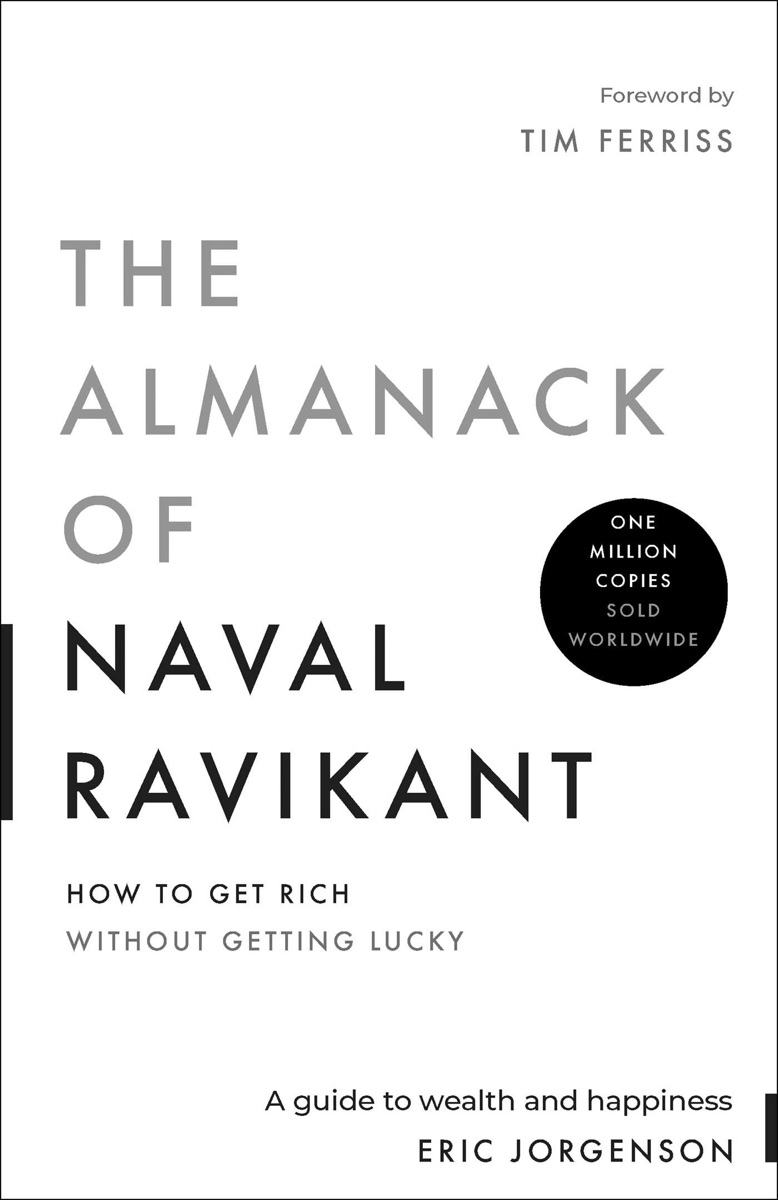
The Almanack of Naval Ravikant
Eric Jorgenson
My take
This is less of a book and more of a compass. Naval Ravikant thinks about wealth, happiness, and freedom in ways that sound obvious once you hear them but that almost nobody actually lives by. What made it hit for me was the integration: he doesn’t separate getting rich from getting happy from getting free. They’re the same project, built on the same foundations: clear thinking, specific knowledge, long-term games, and an honest relationship with what you actually want. I keep coming back to his framing that happiness is not something you chase but something you uncover when you stop needing things to be different. The book is a collection of Naval’s ideas curated from podcasts and tweets, and that format works because it mirrors how his thinking actually lands: in sharp, standalone fragments that you sit with for days.
Core insight 1: Specific knowledge is your unfair advantage
The things you were doing effortlessly as a kid, the skills people noticed before you did, those are your specific knowledge. Society can’t train someone to replace you at the thing that comes naturally to you. This is the opposite of following career advice about “hot industries.” Your edge is in the intersection of your genuine curiosity and the skills you’d do for free.
Specific knowledge is found much more by pursuing your innate talents, your genuine curiosity, and your passion. It’s not by going to school for whatever is the hottest job; it’s not by going into whatever field investors say is the hottest.
No one in the world is going to beat you at being you. The goal isn’t to be the best at someone else’s game. It’s to build a game only you can play.
How to practice: Look at what you were doing as a teenager almost effortlessly. What did people compliment you on before you had a resume? That’s the thread. Follow it, even when it doesn’t look like a career path yet.
Core insight 2: Earn with your mind, not your time
Wealth isn’t about trading hours for money. It’s about building or owning assets that earn while you sleep: businesses, products, media, code. The Industrial Age rewarded time. The modern economy rewards leverage and judgment. The three forms of leverage, labor, capital, and products with no marginal cost of replication, are how individuals scale beyond their own hours.
The most interesting and the most important form of leverage is the idea of products that have no marginal cost of replication. This is the new form of leverage. This was only invented in the last few hundred years. It started with the printing press. It accelerated with broadcast media, and now it’s really blown up with the internet and with coding.
The shift is from “how do I get paid more per hour” to “how do I decouple my income from my time.”
How to practice: Arm yourself with specific knowledge, accountability, and leverage. Ask: does this project create something that can scale without me being there? If the answer is always no, you’re renting out your time.
Core insight 3: Happiness is a skill, not a circumstance
Naval redefines happiness not as constant pleasure but as the absence of desire, the state where nothing feels missing. It’s not something you arrive at after hitting certain milestones. It’s something you practice, like fitness, by building habits that bring your baseline up over time.
Desire is a contract you make with yourself to be unhappy until you get what you want.
A happy person isn’t someone who’s happy all the time. It’s someone who effortlessly interprets events in such a way that they don’t lose their innate peace.
This reframe changes the whole game. You stop chasing happiness through accumulation and start finding it through subtraction.
How to practice: Notice your desires as they arise and ask: is this desire chosen, or is it running me? Happiness compounds when you stop adding conditions to it.
Core insight 4: The power of long-term games
All the returns in life, whether in wealth, relationships, or knowledge, come from compound interest. Short-term thinking is the most expensive habit you can have. The people who win are the ones who play iterated games with the same people for decades, building trust and reputation that compound over time.
Play iterated games. All the returns in life, whether in wealth, relationships, or knowledge, come from compound interest.
If you can’t see yourself working with someone for life, don’t work with them for a day.
This extends beyond business. The friendships, skills, and character traits you invest in today are the ones paying dividends twenty years from now.
How to practice: Before entering any relationship or project, ask: is this a long-term game with a long-term person? If it’s short-term by design, know that going in, and price it accordingly.
Core insight 5: If you can’t decide, the answer is no
Modern life is drowning in options. When you have hundreds of thousands of possible careers, cities, partners, and opportunities, the bar for a “yes” needs to be almost unreasonably high. A lukewarm yes is a slow no.
If you cannot decide, the answer is no. And the reason is, modern society is full of options. There are tons and tons of options.
The scarcity isn’t in opportunity. It’s in clarity about what actually matters to you.
How to practice: Apply this filter to any decision that keeps going back and forth. If it’s not a clear, strong yes after genuine reflection, free yourself by making it a no.
Core insight 6: Meditation as mental inbox zero
Naval describes meditation not as some spiritual practice reserved for monks but as a practical tool for clearing the backlog of unresolved thoughts. Think of your mind as an inbox full of unanswered emails going back to childhood. Meditation is how you process them, one by one, until you reach a state where there’s nothing pending.
What happens in meditation is you’re sitting there and not resisting your mind. These things will start bubbling up. It’s like a giant inbox of unanswered emails, going back to your childhood. They will come out one by one, and you will be forced to deal with them.
Meditation is turning off society and listening to yourself. It only “works” when done for its own sake.
When that inbox empties, what remains is not neutrality. It’s the aliveness that children have, full immersion in the present moment.
How to practice: Start with sixty days of one hour each morning. That sounds extreme, but anything less doesn’t give your mind enough time to surface the deeper backlog. The goal isn’t to control your thoughts, it’s to watch them until they dissolve.
Core insight 7: Radical honesty as freedom
Honesty isn’t just an ethical principle. It’s a practical strategy for living with less friction. The moment you disconnect what you think from what you say, you create multiple threads running in your head, and you lose presence. Naval frames radical honesty as a prerequisite for inner freedom.
Part of being free means I can say what I think and think what I say. They’re highly congruent and integrated. The moment you tell somebody something dishonest, you’ve lied to yourself. Then you’ll start believing your own lie, which will disconnect you from reality.
The closer you want to get to me, the better your values have to be.
How to practice: Start by noticing when you’re editing yourself out of social comfort. You don’t have to be blunt. Combine radical honesty with Warren Buffett’s rule: praise specifically, criticize generally.
Core insight 8: Retirement is a state, not a number
Most people think of retirement as an age or a bank balance. Naval redefines it as a present-tense condition: when you stop sacrificing today for an imaginary tomorrow, you’re retired. When today is complete in itself, you’ve made it.
Retirement is when you stop sacrificing today for an imaginary tomorrow. When today is complete, in and of itself, you’re retired.
The year I generated the most wealth for myself was actually the year I worked the least hard and cared the least about the future. I was mostly doing things for the sheer fun of it.
The paradox: the more you treat today as enough, the more productive and creative your work becomes.
How to practice: Use this as a metric: how much of your day is spent doing things out of obligation rather than out of interest? The gap between those two numbers is how far you are from retirement, regardless of your net worth.
The Almanack is one of those rare books that makes you feel like you already knew everything in it. Naval’s ideas don’t introduce new information so much as strip away the noise around truths you’ve been circling. Wealth, happiness, and freedom aren’t separate pursuits with separate strategies. They’re the same project: get clear on what you actually want, build the leverage to do only that, and stop needing anything to be different than it is.
Other reminders
The three big ones in life are wealth, health, and happiness. We pursue them in that order, but their importance is reverse.
If there’s something you want to do later, do it now. There is no “later.”
People are oddly consistent. Karma is just you, repeating your patterns, virtues, and flaws until you finally get what you deserve. Always pay it forward. And don’t keep count.
Courage isn’t charging into a machine gun nest. Courage is not caring what other people think.
It’s only after you’re bored you have the great ideas. It’s never going to be when you’re stressed, or busy, running around or rushed.
The fundamental delusion: There is something out there that will make me happy and fulfilled forever.
A calm mind, a fit body, and a house full of love. These things cannot be bought. They must be earned.
Peace is happiness at rest, and happiness is peace in motion.
Enjoyed this? You'll like Open Loops.
Every Thursday, I share what I’m learning about growth, work, and the long game. Join 3K+ readers.
You might also like