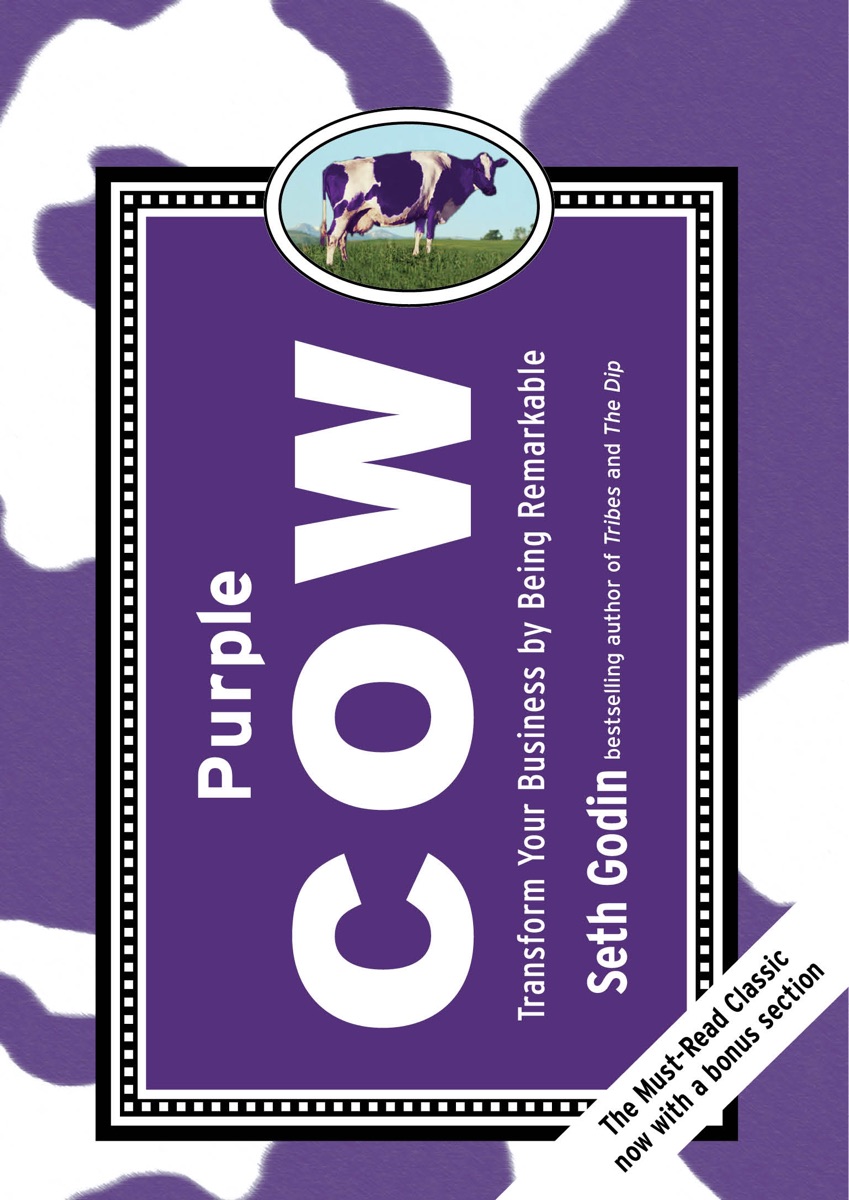
Purple Cow
Seth Godin
My take
Seth Godin wrote this book in 2003 and somehow it’s still the most concise case anyone has made for why playing it safe is the riskiest strategy there is. The premise is simple: in a world drowning in options, the only products and ideas that spread are the ones worth remarking on. Not “good.” Not “better.” Remarkable, as in, someone encounters it and feels compelled to remark on it to someone else. What hit me was not the marketing advice. It was the underlying principle applied to everything: your career, your content, your choices. If what you’re putting out is competent but forgettable, you’ve built something invisible. And invisibility is not a neutral outcome in a crowded world. It’s a death sentence. The uncomfortable truth Godin forces you to confront is that the safe, polished, everyone-will-like-it version of your work is the one no one will talk about. The version that might fail spectacularly is also the only version that might succeed spectacularly.
Core insight 1: Safe is the new risky
The old model worked: build a decent product, buy ads, reach the masses, profit. That model is dead. Consumers have too many choices and too little attention. They’ve learned to ignore everything that doesn’t surprise them. The brands and creators who play it safe are not reducing risk. They’re guaranteeing irrelevance.
In a crowded marketplace, fitting in is failing. In a busy marketplace, not standing out is the same as being invisible.
In your career, even more than for a brand, being safe is risky. The path to lifetime job security is to be remarkable.
How to practice: Look at the project you’re currently working on. Ask honestly: would anyone who encountered this feel compelled to tell someone about it? If not, you haven’t found the remarkable element yet. Don’t ship until you do.
Core insight 2: Create for the sneezers, not the masses
Godin’s key strategic insight is that you don’t need everyone to love what you make. You need a small group of passionate people who will spread the word. He calls them “sneezers,” the early adopters with influence and energy. These are the people who obsess, who tell their friends, who blog about what they found. Building for them first, not for the safe middle, is how ideas actually spread.
Do you have the email addresses of the 20 percent of your customer base that loves what you do? If not, start getting them. If you do, what could you make for these customers that would be superspecial?
Consumers with otaku are the sneezers you seek. They’re the ones who will take the time to learn about your product, take the risk to try your product, and take their friends’ time to tell them about it.
How to practice: Identify the 20 people who care most about what you do. Not your biggest customers. Your most enthusiastic ones. Ask them what would make your work irresistible to them. Then build that. The masses follow the sneezers, not the other way around.
Core insight 3: Marketing is not a department, it’s the product itself
This is where Godin breaks from traditional thinking most sharply. Marketing is not the thing you do after you make the product. It is the product. The design, the experience, the story, the way it makes people feel: all of that is marketing. If you need to “add marketing” after the fact, you’ve already lost. The remarkable thing has to be baked in from the beginning.
The old rule was this: create safe, ordinary products and combine them with great marketing. The new rule is: create remarkable products that the right people seek out.
As consumers, we’re too busy to pay attention to advertising, but we’re desperate to find good stuff that solves our problems.
How to practice: The next time you’re planning a launch, spend 80% of your time on the product and 20% on promotion, not the reverse. If the product is genuinely remarkable, promotion becomes the easy part. People do the spreading for you.
Core insight 4: Criticism is proof that you’re visible
If you’re remarkable, some people won’t like you. That’s not a side effect. It’s the definition. The timid can hope for indifference. The remarkable will get both fans and critics. Godin reframes negative feedback not as failure but as evidence that you’ve actually registered in someone’s consciousness, which is more than most things achieve.
If you’re remarkable, it’s likely that some people won’t like you. That’s part of the definition of remarkable. Nobody gets unanimous praise, ever. The best the timid can hope for is to be unnoticed.
You do not equal the project. Criticism of the project is not criticism of you.
That second line is the one worth internalizing. The ability to separate your identity from your work is what allows you to take the risks that make the work remarkable in the first place.
How to practice: Ship something that makes you nervous. If everybody likes it, you probably didn’t push hard enough. Track the ratio: if no one objects, it’s forgettable. If some people object while others are thrilled, you’ve probably found something worth pursuing.
Core insight 5: Iterate, don’t protect
The companies that stay remarkable are the ones that keep reinventing, not the ones that defend what worked last time. Godin uses the example of companies that made a Purple Cow, got rich, then spent all their energy protecting the cow instead of breeding the next one. The moment you start optimizing for safety, you’ve begun the slide back to ordinary.
If a product’s future is unlikely to be remarkable, if you can’t imagine a future in which people are once again fascinated by your product, it’s time to realize that the game has changed. Instead of investing in a dying product, take profits and reinvest them in building something new.
The Purple Cow is not a cheap shortcut. It is, however, your best, perhaps only, strategy for growth.
How to practice: Set a regular review, quarterly or monthly, where you ask: is this still remarkable? Has the market caught up? If the answer is yes, start building the next thing before the current one fades. The worst time to innovate is when you’re forced to.
Purple Cow is a short book with a long shadow. The idea that remarkable beats safe is easy to understand and almost impossible to practice consistently, because the institutional pressure to play it safe never stops. Every meeting, every committee, every “let’s run it by legal” is a gravitational pull toward the ordinary. The book’s real gift is not the insight. It’s the permission to ignore that gravity.
Other reminders
The purity of the message makes it even more remarkable. It’s easy to tell someone about the Leaning Tower. Much harder to tell them about the Pantheon in Rome.
We run our schools like factories. We line kids up in straight rows, put them in batches called grades, and work very hard to make sure there are no defective parts. Playing it safe. Following the rules.
If times are tough, your peers may say you can’t afford to be remarkable. In good times, they’ll tell you to relax and play it safe. So when is the right time?
Instead of trying to use your technology and expertise to make a better product for your users’ standard behavior, experiment with inviting the users to change their behavior to make the product work dramatically better.
Marketing is too important to be left to the marketing department.
Enjoyed this? You'll like Open Loops.
Every Thursday, I share what I’m learning about growth, work, and the long game. Join 3K+ readers.
You might also like