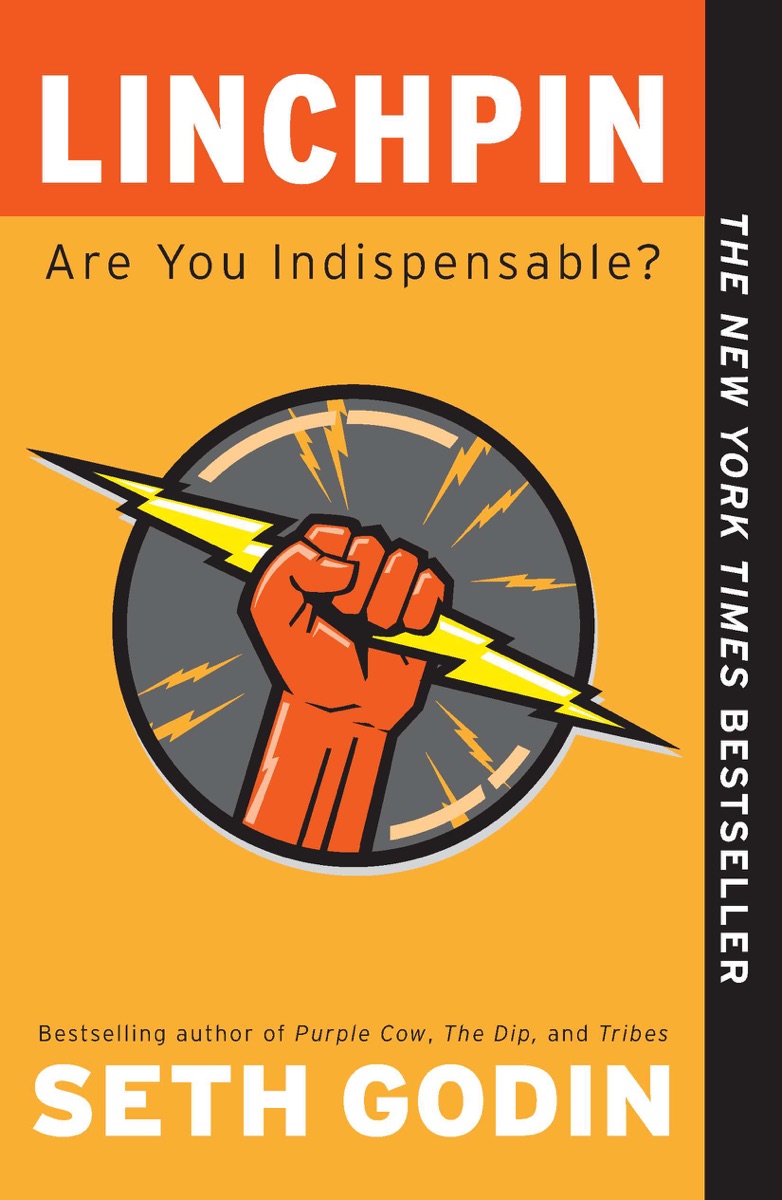
Linchpin
Seth Godin
My take
I picked this up while trying to get more efficient at work that, if I’m honest, almost anyone could have done. Godin’s argument hit me sideways: the more replaceable you make yourself, the less you’re worth, and most of us have been complicit in our own commoditization. We were trained for the factory. Follow the map, do the work that needs doing anonymously, keep your head down, and call that safety. Linchpin is his case that the trade stopped paying out. The only security left is to become someone a job description can’t capture: the person who brings judgment, generosity, and art to the room, who does the work no one can hand you a script for, and who ships it anyway. What stayed with me wasn’t the career advice. It was the permission. The part of the work I’d been treating as optional, the human part, the part with my actual fingerprints on it, turns out to be the only part that’s scarce.
Core insight 1: The deal you were sold is broken
We grew up inside an unspoken trade: be reliable, be interchangeable, and in exchange you get safety. Godin’s point is that the trade quit paying out. The easier you are to swap for someone cheaper, the less reason anyone has to keep you. Being replaceable used to feel like humility. Now it reads as exposure.
The easier people are to replace, the less they need to be paid. And so far, workers have been complicit in this commoditization.
You don’t become indispensable merely because you are different. But the only way to be indispensable is to be different. That’s because if you’re the same, so are plenty of other people.
How to practice: Look back at your week and mark which parts a competent stranger could have done. That list is your replaceable surface. The value lives in everything left over.
Core insight 2: The job is not the work
Godin draws a line between your job and your work. The job is the part someone can describe, assign, and measure. The work is what you do when no one can tell you exactly how. He calls that art, and he means it widely: a spreadsheet, a sales call, a way of seeing can all be art when you put yourself into them.
The job is not your work; what you do with your heart and soul is the work.
If there were a map, there’d be no art, because art is the act of navigating without a map.
How to practice: Notice the moments at work that come with no instructions. Those gaps aren’t where you’re failing the job. They’re where the work actually begins.
Core insight 3: The lizard brain is why you hide
The reason most of us play small isn’t a skill gap. It’s an old part of the brain that reads visibility as danger and treats safety as the highest good. Godin names it the lizard brain, the source of the resistance. Naming it matters, because once you can feel it as a separate voice, you stop confusing its fear with your judgment.
The lizard brain is the reason you’re afraid, the reason you don’t do all the art you can, the reason you don’t ship when you can. The lizard brain is the source of the resistance.
The linchpin feels the fear, acknowledges it, then proceeds.
How to practice: When you feel the pull to add one more revision, ask one more person, wait one more day, read it as a signal you’re close to something that counts. The fear spikes hardest right before the work matters.
Core insight 4: You have to ship
An idea that never meets the world isn’t art, it’s a daydream with good production values. Godin is relentless here: the whole purpose of starting is to finish, and finishing means letting the thing collide with reality. Most unfinished work isn’t unfinished for lack of time. It’s being protected from judgment on purpose.
Shipping is the collision between your work and the outside world.
Done is the engine of more.
How to practice: Take the project you’ve been polishing and set a date you’ll let someone see it. Shipping rough beats hoarding perfect, because only the version that ships can teach you anything.
Core insight 5: Generosity is the strategy, not the side effect
We’re taught to guard our value and hold back until we’re paid for it. Godin flips the order. The linchpin gives first: the extra connection, the problem solved that wasn’t theirs, the gift offered with no meter running. It feels like a cost right up until you notice that generosity is what makes people unwilling to lose you.
Passion is caring enough about your art that you will do almost anything to give it away, to make it a gift, to change people.
Generosity generates income.
How to practice: Find one place this week to do more than the transaction asks for, with nothing attached. Notice who remembers. That memory is the asset.
Core insight 6: Indispensable means doing the work that isn’t yours
In a factory, stepping outside your role is a hazard. In the work Godin describes, it’s the entire point. The linchpin is the person who spots the thing falling through the cracks and picks it up before anyone assigns it. Not because it’s their job, but because they’ve stopped waiting to be told.
In a factory, doing a job that’s not yours is dangerous. Now, if you’re a linchpin, doing a job that’s not getting done is essential.
She solves problems that people haven’t predicted, sees things people haven’t seen, and connects people who need to be connected.
How to practice: Hunt for the gap nobody owns. Filling it is rarely in your description, which is exactly why it makes you hard to replace.
Core insight 7: What’s scarce now is judgment, not information
Knowing things used to be a moat. The internet drained it. Godin’s reframe is that value moved from having information to knowing what to do with it: taste, judgment, the call you make when the data runs out. The more easily a thing can be measured or looked up, the less it’s worth, because anyone can measure or look it up.
Today, if all you have to offer is that you know a lot of reference book information, you lose, because the Internet knows more than you do.
Depth of knowledge combined with good judgment is worth a lot.
How to practice: Stop competing on how much you know. Compete on the quality of the decisions you make when the answer can’t be looked up.
Linchpin reframes the word safety. The cautious path, stay replaceable, follow the map, keep your head down, is the one that’s actually exposed now. The only durable security is to become someone the world would feel the loss of, and that asks for the parts of you a role can’t name: your judgment, your generosity, your willingness to ship something with your name on it. That’s not a bigger job. It’s a different posture toward the one you already have.
Other reminders
The secret to being wrong isn’t to avoid being wrong. The secret is being willing to be wrong. The secret is realizing that wrong isn’t fatal.
If you are deliberately trying to create a future that feels safe, you will willfully ignore the future that is likely.
If your agenda is set by someone else and it doesn’t lead you where you want to go, why is it your agenda?
Mediocre is merely a failed attempt to be really good.
If it wasn’t a mystery, it would be easy. If it were easy, it wouldn’t be worth much.
You become a winner because you’re good at losing.
Where did your art go while you were tweeting?
Going out of your way to find uncomfortable situations isn’t natural, but it’s essential.
Enjoyed this? You'll like Open Loops.
Every week I share ideas on clarity, growth, and building a life that feels like yours. Join 3K+ readers.
You might also like